
The right differential-speed adjustment isn’t always the one that produces the driest cake. When adjusting differential speed on a decanter centrifuge, a slower setting generally gives solids longer in the bowl and may improve cake dryness, while a faster setting can increase solids discharge and throughput. Feed conditions, torque and centrate quality all matter, so changing one setting in isolation can trade one process objective for another.
If you’re weighing whether to increase or reduce differential speed, the uncertainty is understandable. Bowl and scroll speeds work together, and a change that helps one result may affect capacity, torque or operating stability. A controlled approach is more reliable than reacting to a single sample or alarm.
This guide explains how bowl speed, scroll speed and differential speed relate, then outlines a practical process for making and assessing an adjustment within your site procedures. It covers how to compare cake and centrate results with torque and throughput, allow for the process response, and recognise when you need equipment documentation, operating data or technical support before making further changes.
Key Takeaways
- Check your installed machine’s OEM documentation to confirm how it defines and controls differential speed before changing a setting.
- Assess cake condition, centrate quality, throughput and torque together. A change that benefits one measure may affect another.
- Set a clear process objective and record stable baseline readings, including feed conditions and discharge observations.
- When adjusting differential speed on a decanter centrifuge, use approved controls and follow site procedures, operating limits and authorisation requirements.
- Where practicable, compare results under equivalent conditions. Review persistent issues using operating data and appropriate technical support.
What differential speed means on a decanter centrifuge
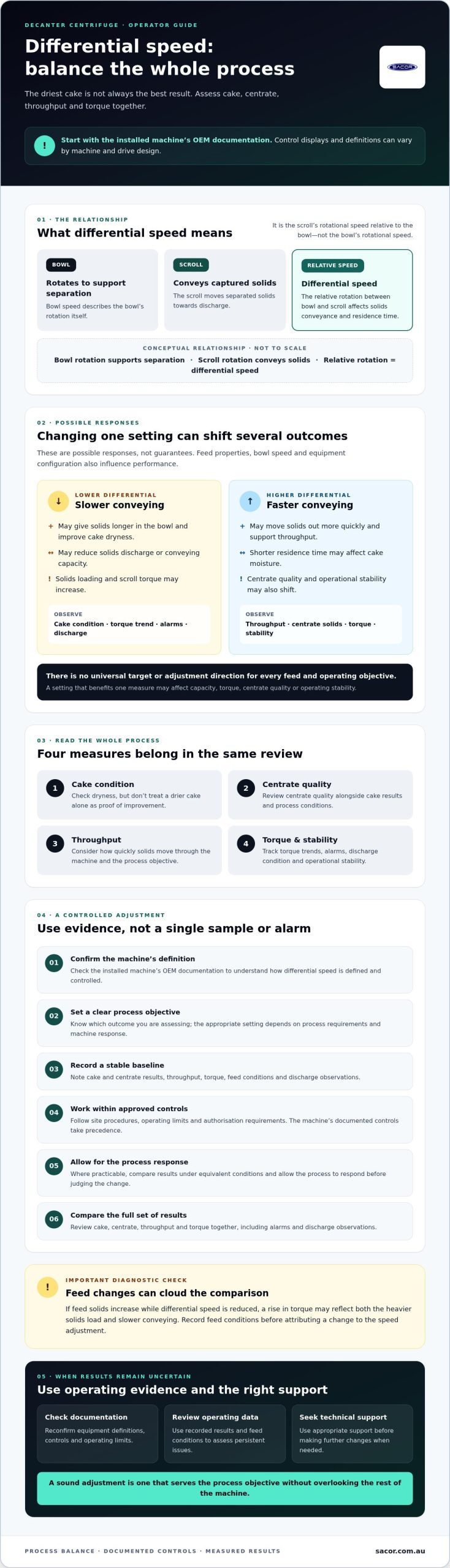
A decanter centrifuge separates solids from liquid as the bowl rotates and the internal scroll conveys captured solids towards the discharge. Differential speed describes the relative rotational speed between these components. It is distinct from bowl speed, which refers to the bowl’s rotation itself. For an overview of the equipment and its operating principles, see Decanter centrifuge.
Differential speed is the rate at which the scroll rotates relative to the bowl, not the bowl’s rotational speed. Control displays and terminology can vary with machine and drive design. Before interpreting or changing a displayed value, check how your equipment defines it in the OEM documentation.
How bowl speed and scroll speed create the differential
The bowl and scroll rotate in relation to one another but have different roles. Bowl rotation supports separation, while the scroll moves separated solids through the bowl. Their relative speed affects how quickly solids are conveyed and how long they remain in the separation zone. The control method depends on machine design, so don’t assume every drive system calculates or displays differential speed in the same way.
Conceptual diagram, not to scale: Bowl rotation supports separation | Scroll rotation conveys solids towards discharge | Relative bowl-to-scroll speed = differential speed
Why operators adjust differential speed
Operators consider differential speed when balancing solids conveyance, cake condition and overall separation performance. The setting influences how quickly solids move through the machine, but it doesn’t determine the result on its own. Feed properties, bowl speed and equipment configuration also affect performance, so a setting that suits one process may not suit another.
There is no universal target or adjustment direction for every feed and operating objective. The suitable setting depends on process requirements and how the installed machine responds. For that reason, adjusting differential speed on a decanter centrifuge should be guided by process evidence and the equipment’s documented controls, not a general rule or a setting used on another machine.
How differential speed affects cake, centrate, torque and throughput
Differential speed influences how quickly the scroll conveys solids through the bowl, shifting the balance between solids residence time and conveying capacity. A lower setting may allow solids to remain longer and produce a drier cake, but it can also increase solids loading and torque. A higher setting may move solids out more quickly, potentially supporting throughput while reducing residence time. These are possible responses, not guaranteed outcomes.
What a lower differential speed may change
Slower conveying can give solids more time in the bowl, which may improve cake dryness under suitable feed and operating conditions. It may also reduce the rate at which solids discharge, and accumulated solids can affect scroll torque. Track torque trends, machine alarms and discharge condition alongside cake results. A drier cake alone doesn’t confirm that the adjustment is beneficial.
What a higher differential speed may change
Faster conveying can increase solids movement through the bowl and may help manage loading, but it can shorten solids residence time and affect cake moisture. Throughput and centrate quality may also shift, depending on feed solids concentration and characteristics. Differential speed cannot be optimised independently of feed conditions, torque and the process objective.
Use the comparison below as a guide to possible responses only. The installed machine’s OEM documentation, operating limits and site procedures take precedence.
| Indicative adjustment | Possible process response | Observe |
|---|---|---|
| Lower differential | Longer solids residence, potentially drier cake, lower conveying capacity or increased solids loading | Cake condition, torque trend, alarms and discharge |
| Higher differential | Faster solids conveyance, potentially wetter cake, greater conveying capacity or changed centrate quality | Throughput, centrate solids, torque and operational stability |
Feed-rate changes can make a speed adjustment difficult to assess. For example, if feed solids increase while differential speed is reduced, a rise in torque may reflect both the heavier solids load and slower conveying. Record feed conditions and other relevant operating settings so you can interpret the trend rather than attributing every change to differential speed. Where practicable, compare results under equivalent conditions.
If performance remains difficult to interpret, reviewing machine configuration and process data with decanter centrifuge technical support can help identify what to assess before making further changes.
How to diagnose the right differential-speed adjustment
Start by defining the process objective. It might be improving cake condition, clarifying centrate, maintaining throughput or keeping operation stable. Then establish a reliable baseline before adjusting anything. Record feed characteristics and flow rate, bowl speed, differential speed, torque, cake and centrate observations, and relevant upstream changes. Use the installed machine’s terminology and your site’s recording methods.
While assessing a change, keep other conditions as steady as practicable. Variations in feed solids, polymer addition, flow rate or upstream processing can alter separation results and torque, making it difficult to isolate the effect of differential speed. If these conditions change, record them alongside machine data rather than treating the adjustment as the only possible cause.
Use cake and centrate observations as diagnostic evidence
Record cake appearance and centrate clarity consistently over comparable operating periods. Note changes rather than relying on a single observation, and check for feed variability or upstream process changes before linking a result to the speed setting. Where solids-content measurements are available, compare samples using your site’s established sampling method and record the operating conditions at the time.
Use torque and throughput to assess operating limits
Review torque trends alongside feed rate and differential-speed changes. A torque rise may coincide with a setting change, but increased feed solids or flow may also contribute. Rising torque, alarms or abnormal vibration call for the relevant site procedures and equipment guidance, not an assumption that another speed adjustment is appropriate. In mining applications, feed characteristics and process objectives also shape interpretation. See the relevant guide to decanter centrifuges in Australian mining for application context.
Use the table to structure an investigation, not to diagnose a fault. Treat each possible cause as a hypothesis to check against process records, measurements and the OEM documentation.
| Observed symptom | Check first | Diagnostic note |
|---|---|---|
| Cake appears wetter | Feed conditions, differential speed and bowl speed | Check whether conditions were comparable with the baseline. |
| Centrate appears less clear | Feed solids, flow rate and centrate sample method | Check for process changes before attributing the result to speed. |
| Torque is rising | Torque trend, feed rate and feed solids | Follow site procedures if torque approaches documented limits or alarms occur. |
| Throughput has changed | Feed flow, discharge condition and operating settings | Separate a feed-rate change from a change in solids-conveying performance. |
With a clear objective and consistent baseline, adjusting differential speed on a decanter centrifuge becomes a testable process change rather than a guess. If evidence points to persistent performance issues, review the operating data and installed configuration with appropriate technical support before making further changes.
How to adjust differential speed on a decanter centrifuge safely and assess the result
Use the OEM documentation, site procedures and documented operating limits as the authority for any adjustment. Only trained, authorised personnel should change differential-speed settings, using the machine’s approved controls. The method and terminology can differ between installations, so don’t rely on generic instructions or settings from another centrifuge.
Before adjusting differential speed on a decanter centrifuge, confirm the process objective and establish a stable baseline. Review current alarms and relevant machine limits, then record the operating conditions and observations you’ll use to assess the change. This gives the site team a clear reference if results shift or the setting needs to be reversed.
A controlled adjustment sequence for trained operators
- Confirm readiness. Check the objective, baseline readings, current alarms and applicable operating limits against the OEM documentation and site procedures.
- Make one approved change. Use the documented control method and select only a small change permitted by the procedure. Avoid changing several process settings at once, as this makes the result harder to interpret.
- Observe and record. Allow the observation period set by site procedure. Track torque, throughput, cake condition, centrate quality and operational stability against the baseline.
- Decide based on evidence. Record the setting, operating conditions, observations and decision to retain or reverse the change. Confirm that the selected response remains within documented limits.
Keep feed conditions and other relevant settings as consistent as practicable during the observation period. If they change, note the difference in the record. Otherwise, it may be difficult to tell whether the outcome followed the adjustment or another process change.
When to stop, reverse or escalate
If alarms, instability or abnormal operating conditions arise, follow site procedures immediately. Don’t bypass interlocks or continue testing outside documented operating limits. Stop, reverse or escalate only as directed by the applicable procedure and authorised personnel. If the cause or safe response isn’t clear, pause further adjustments and seek appropriate technical guidance.
For broader equipment context, consider how system configuration and process requirements shape operating guidance across industrial decanter centrifuge systems. If your team needs help reviewing machine configuration or operating data, contact Sacor for technical support.
How to confirm an improvement and plan ongoing optimisation
A setting change counts as an improvement only if it advances the process objective without creating an unacceptable trade-off elsewhere. Compare results with the original baseline under equivalent feed and operating conditions where practicable. Assess cake condition, centrate quality, throughput, torque and operational stability together rather than treating one favourable reading as proof of success.
Feed variability can change the result even when machine settings remain constant. Note differences in feed solids, flow rate, polymer addition or upstream conditions, and avoid comparing unlike operating periods as if they were a controlled test. If conditions vary, record that context and interpret the results accordingly.
Build a repeatable performance record
Maintain a log that captures differential speed, bowl speed, torque, feed conditions and relevant cake, centrate and discharge observations. Include the adjustment made and the decision to retain or reverse it. Comparing like-for-like periods helps the team identify whether a result is repeatable and provides a useful reference when feed conditions change.
If performance deteriorates alongside signs of wear or a component issue, investigate equipment condition rather than continuing to alter settings. Spare-parts information may be relevant if inspection or maintenance identifies a component concern. It shouldn’t replace a process review when the cause is uncertain.
When Sacor technical support may help
Persistent torque, separation or capacity issues warrant a closer review if controlled adjustments and consistent records haven’t clarified the cause. A process-specific assessment can consider feed characteristics, operating data and machine configuration together. Sacor supplies decanter centrifuge systems and provides commissioning and technical support, which can help plant teams assess equipment and process requirements without assuming that a particular setting will deliver a guaranteed result.
Use the evidence gathered while adjusting differential speed on a decanter centrifuge to guide the next decision. If results remain inconsistent, discuss the process data and equipment configuration with a technical specialist rather than making further unstructured changes.
Discuss your decanter centrifuge process requirements with Sacor.
Make each adjustment evidence-led
Effective differential-speed optimisation starts with a clear process objective and a reliable baseline. Bowl and scroll speeds work together, but the suitable setting depends on feed conditions, machine configuration and the outcomes your plant needs. Treat each change as a controlled test, then assess cake, centrate, throughput, torque and stability together before deciding whether to retain it.
When adjusting differential speed on a decanter centrifuge, follow the OEM documentation, site procedures and operating limits, and ensure only trained, authorised personnel make changes. Consistent records help distinguish a genuine improvement from the effects of changing feed or other operating conditions. If results remain inconsistent, review the process and equipment data rather than continuing with unstructured adjustments.
Sacor supplies decanter centrifuge systems with technical documentation and commissioning support, and works with plant engineers and managers on process-specific solutions. Maintenance, spare-parts supply and technical support are also available to address relevant equipment and operating requirements. Discuss your decanter centrifuge process requirements with Sacor.
A measured approach and appropriate technical input help your team make informed decisions and work towards more consistent separation performance.
Frequently Asked Questions
What is differential speed on a decanter centrifuge?
Differential speed is the relative rotational speed between the bowl and the scroll, which conveys separated solids through the machine. It’s distinct from bowl speed, although both influence separation and solids transport. Control terminology and calculation can vary by machine design, so check the installed equipment’s documentation to confirm what the displayed value represents. Don’t change a setting based on an assumed definition or terminology from another centrifuge.
How does differential speed affect cake dryness?
Differential speed affects how quickly solids move through the bowl and how long they remain in the separation zone. A change may influence cake condition, but it won’t guarantee a drier result. Feed characteristics, bowl speed and other operating variables also matter. Compare cake samples taken under equivalent conditions using your site’s established method. Assess the result alongside centrate quality, torque and throughput, rather than relying on cake appearance alone.
Should differential speed be increased or decreased to improve centrate quality?
There’s no universal direction that will improve centrate quality across all feeds and machines. First confirm the centrate issue and record a stable baseline, including relevant feed and operating conditions. If an adjustment is warranted, follow the OEM method and site limits, and ensure only authorised personnel make the change. Monitor centrate, cake, torque and throughput together before deciding whether to retain or reverse it.
Can changing differential speed increase decanter centrifuge torque?
Yes, a differential-speed change can affect solids conveyance and the load experienced by the scroll, which may alter torque. The response depends on the machine and process, and feed rate or solids concentration can also influence readings. Track torque alongside feed conditions and operating changes. If readings approach documented limits, alarms occur or the machine becomes unstable, follow site procedures rather than making further adjustments by assumption.
What should operators monitor after adjusting differential speed?
Record the new setting and compare cake condition, centrate quality, throughput and torque with a stable baseline. Keep feed conditions, bowl speed and other relevant settings in view, since simultaneous changes make cause and effect harder to establish. Use approved site sampling and observation methods, and allow the observation period specified by site procedure. Retain or reverse a setting only in accordance with the OEM documentation and site procedures.
How often should differential speed be adjusted?
Adjust differential speed according to process evidence and documented site procedures, not an assumed routine schedule. A change in feed or separation results may prompt operators to review the setting, but the OEM documentation and site procedure determine the appropriate response. Record each authorised adjustment and its outcome. If the setting is being changed repeatedly without a clear explanation or consistent improvement, pause trial-and-error changes and arrange a process and equipment review.
Is it safe to adjust differential speed while a decanter centrifuge is running?
Only trained, authorised personnel should adjust the setting, and only if the installed equipment’s documentation and site procedure permit adjustment during operation. Use approved controls and stay within documented operating limits. Never bypass interlocks or approach moving equipment. Requirements vary with machine and control-system design, so don’t assume an adjustment can be made while running. If an alarm, abnormal vibration or unstable operation occurs, follow the site response procedure before considering any change.