
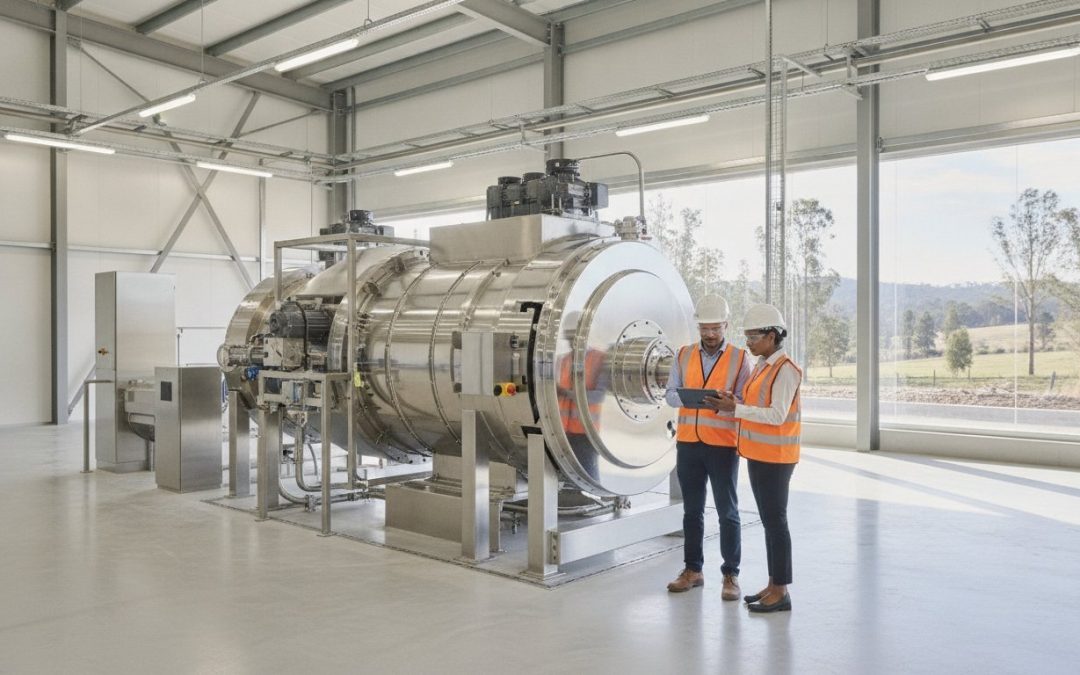
In the Australian wastewater sector, high-performance dewatering is now a regulatory necessity rather than an operational choice. A high-efficiency biosolids dewatering centrifuge serves as the critical link between meeting 2026 compliance standards and facing escalating disposal levies. Plant managers across the country are currently grappling with rising transport costs and the tightening of PFAS concentration thresholds in states like New South Wales and Queensland. It’s clear that legacy equipment often fails to keep pace with these modern environmental and economic pressures.
This strategic guide demonstrates how to optimise your dewatering processes to achieve higher cake solids concentration while significantly reducing polymer usage and energy consumption. By prioritising precision engineering and reliability, you can transform your biosolids management from a cost centre into a streamlined operation. We’ll examine the latest regulatory updates, technical benchmarks for 2026, and how local technical support ensures your plant remains both compliant and cost-effective over the long term.
Key Takeaways
- Identify how a high-performance biosolids dewatering centrifuge achieves superior cake dryness to lower transport and disposal expenses.
- Compare the operational advantages of decanter systems against belt and filter presses, focusing on footprint efficiency and reduced chemical consumption.
- Navigate the 2026 Australian regulatory requirements for biosolids stabilisation and grading to support compliant agricultural reuse.
- Recognise the value of bespoke engineering and local technical support in maintaining reliable, long-term plant performance.
- Optimise internal process variables, such as feed rates and scroll speeds, to ensure consistent separation results across varying sludge characteristics.
What is a Biosolids Dewatering Centrifuge?
Biosolids dewatering is the mechanical process of separating liquid from solid organic matter. This stage is vital in wastewater treatment, as it transforms liquid residuals into a manageable solid form. A modern biosolids dewatering centrifuge facilitates this by applying high rotational speeds to achieve a high-solids cake discharge. This transition from viewing the material as ‘sludge’ to ‘biosolids’ reflects a broader Australian shift toward a resource-recovery mindset. It’s no longer just about disposal; it’s about preparing a product for beneficial reuse in agriculture or industry.
The sludge dewatering process is essentially an exercise in volume reduction. By removing water, plant operators can drastically reduce the physical mass of the material. This leads to lower transport requirements and significantly decreased disposal fees at landfill or composting sites. For many Australian facilities, the efficiency of this separation determines the overall commercial viability of their waste management strategy.
The Core Function of Centrifugal Separation
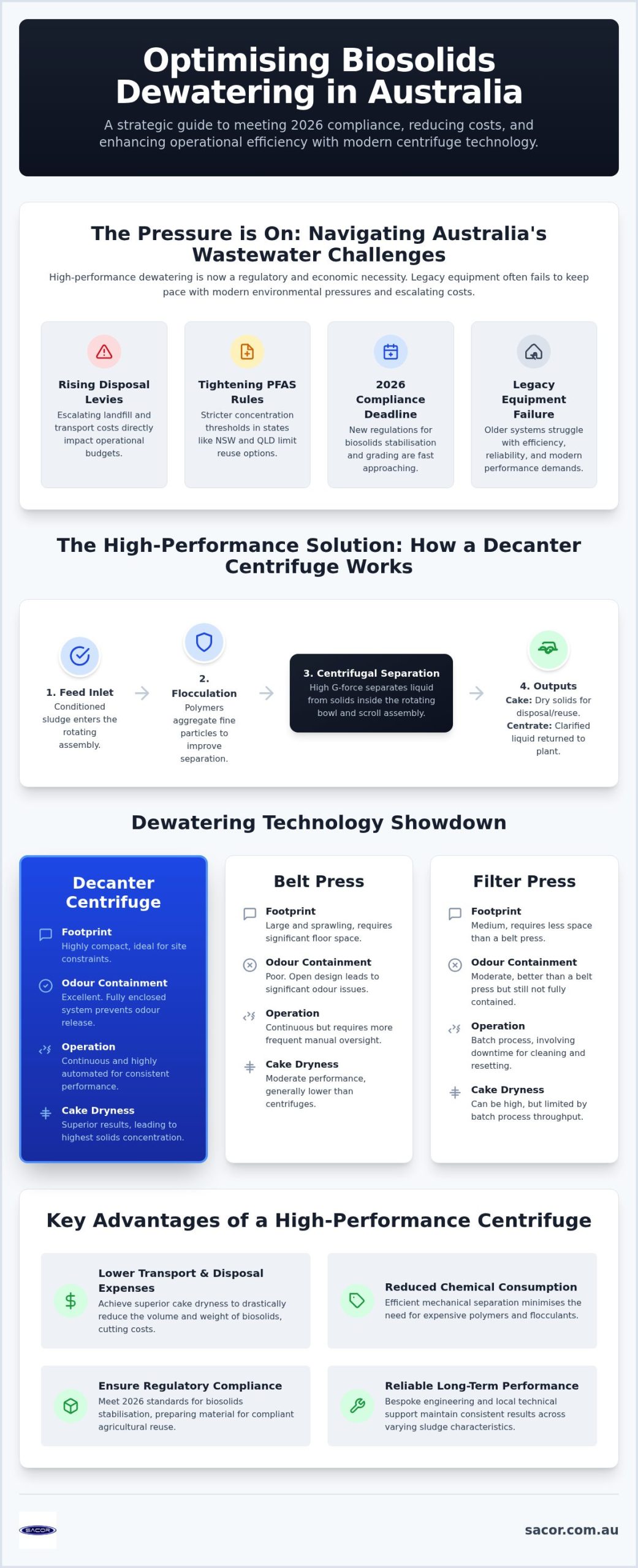
Centrifugal separation relies on extreme G-force to accelerate the settling of fine organic particles. Inside the centrifuge, the feed material is spun at high speeds, forcing the heavier solids against the bowl wall. Unlike batch processes that require downtime for cleaning or resetting, a decanter centrifuge operates continuously. This ensures a steady throughput and consistent performance. The process yields two distinct streams: the ‘cake’, which is the concentrated solid material, and the ‘centrate’, the clarified liquid that is returned to the treatment plant for further processing.
Why Industrial Operators are Moving to Centrifuges
Industrial operators increasingly prefer centrifugal systems due to their compact footprint. Compared to traditional drying beds or sprawling belt presses, a decanter centrifuge requires minimal floor space, making it ideal for plants with site constraints. The fully enclosed nature of the system is another major advantage. It provides superior odour containment, which is crucial for facilities located near residential or commercial zones. Additionally, the reliability of a biosolids dewatering centrifuge ensures that plants can meet their daily throughput targets regardless of fluctuations in the incoming sludge profile. These systems handle varying feed concentrations effectively, maintaining high performance without the need for constant manual intervention.
How the Dewatering Process Works
The operational cycle of a biosolids dewatering centrifuge begins at the feed inlet, where conditioned sludge enters the rotating assembly. Before reaching the centrifuge, the sludge undergoes a critical pre-treatment phase involving flocculants. These polymers aggregate fine particles into larger flocs, which significantly improves the efficiency of the subsequent separation. Without precise chemical dosing, achieving a clear liquid discharge becomes nearly impossible. The sludge then travels through the feed pipe into the bowl’s acceleration chamber, where it’s quickly brought up to process speed.
The Mechanics of the Decanter Bowl and Scroll
Rotation of the cylindrical bowl at high speeds creates the centrifugal force necessary to pin solids against the inner wall. Inside this bowl, the internal screw conveyor, or scroll, rotates in the same direction but at a slightly different speed. This differential speed is the mechanism that constantly pushes the settled solids toward the conical end for discharge through the solids ports. Pond depth refers to the thickness of the liquid layer inside the bowl, and adjusting this level is the primary method for balancing centrate clarity against cake dryness. A deeper pond increases retention time for the liquid, whereas a shallower pond allows more time for the solids to dry on the beach section of the bowl.
Optimising Throughput and Cake Dryness
Managing a centrifuge involves a constant trade-off between feed rate and retention time. Control is paramount. Increasing the throughput often reduces the time solids spend under G-force, which can lead to wetter cake and higher disposal costs. Modern systems utilise sophisticated torque control to monitor the load on the scroll, automatically adjusting the differential speed to prevent blockages or mechanical strain. These automated control systems are essential for reliable operation, allowing the equipment to respond to changes in feed consistency without operator intervention.
For those seeking detailed design criteria and performance benchmarks, the EPA centrifuge dewatering fact sheet provides a technical baseline for these performance variables. If your facility requires a system tailored to specific feed characteristics, exploring customised decanter centrifuge systems can ensure long-term operational stability and energy efficiency.
Centrifuge vs. Belt Press vs. Filter Press
Australian wastewater facilities typically choose between three primary mechanical dewatering technologies: decanter centrifuges, belt filter presses, and plate-and-frame filter presses. While each has its place, the selection of a biosolids dewatering centrifuge is increasingly common for plants prioritising high performance and minimal footprint. Unlike belt presses that rely on porous belts and gravity, or filter presses that operate in batches, centrifugal systems provide a continuous, high-intensity separation environment. This distinction is critical when aligning with the Australian biosolids management guidelines, which emphasise the importance of consistent stabilisation and volume reduction.
Performance Metrics for Australian Plants
In terms of output, the performance gap between these technologies is significant. A centrifuge typically produces cake solids between 20% and 35%, whereas a belt press often plateaus between 15% and 25%. This 10% difference represents a massive reduction in the total weight of material transported off-site. Additionally, centrifuges are remarkably efficient with water. They require up to 90% less wash-water than belt presses because they don’t have belts that need constant rinsing. For urban-adjacent sites, the enclosed design of a centrifuge provides superior odour containment and noise dampening compared to the open-air operation of a belt press.
Total Cost of Ownership (TCO) Analysis
A common misconception persists that the maintenance of a centrifuge is prohibitively expensive. While the initial capital outlay and specialised parts require a planned budget, the total cost of ownership (TCO) often tells a different story. The savings generated from reduced transport volumes and lower landfill levies usually offset maintenance costs within a few years. Higher cake dryness directly translates to fewer truck movements and lower disposal fees. Automation also plays a vital role in reducing operational costs. Modern centrifuges require far less operator supervision than belt or filter presses, allowing staff to focus on other plant priorities. For a more detailed breakdown of these economic factors, you can consult our guide on industrial decanter centrifuge Australia.
Compliance and Operational Standards in Australia
Compliance in the Australian wastewater sector has undergone significant shifts in 2026, particularly regarding the management of persistent contaminants. The implementation of a biosolids dewatering centrifuge is now central to meeting the updated risk-based frameworks adopted by state environmental protection agencies. These regulations focus on the physical and chemical stability of the final product, ensuring that any material destined for land application doesn’t pose a threat to soil health or groundwater. Achieving these outcomes requires a high level of process control that only modern centrifugal separation can provide consistently.
Meeting State-Based EPA Guidelines
The classification of biosolids into grades, such as T1 or T2, depends heavily on the effectiveness of the dewatering stage. High moisture content often correlates with lower stabilisation, which can restrict the beneficial reuse of solids in agriculture. In New South Wales, for instance, the 2026 gazettal of new Resource Recovery Orders and Exemptions has introduced tighter concentration thresholds for specific contaminants. A centrifuge helps operators meet these standards by producing a consistent, repeatable cake dryness that simplifies the auditing process. Reliable results are essential for maintaining the robust technical documentation and commissioning records required during environmental inspections. Proper dewatering also improves the handling and storage characteristics of the treated solids, reducing the risk of leachate runoff at storage sites.
Safety and Environmental Risk Mitigation
Environmental responsibility extends beyond the final product to the safety of the plant itself. Enclosed centrifugal systems are superior for managing hazardous gases like hydrogen sulphide (H2S), which can accumulate in open-air dewatering setups. By containing these vapours, plants protect their workforce and minimise the impact on the surrounding atmosphere. Safety is further enhanced through integrated vibration monitoring and emergency stop systems that prevent mechanical failure during high-speed operation. For a deeper look at how these systems integrate into broader plant goals, see our wastewater treatment centrifuge Australia guide. These technical safeguards ensure that efficiency never comes at the expense of site safety or environmental integrity.
Operating within the 2026 regulatory landscape demands more than just equipment; it requires a partner who understands local compliance nuances. If you’re looking to upgrade your facility to meet these new standards, you can find more information about our Wastewater Treatment Separation Solutions online.
Custom Separation Solutions with Sacor
Sacor positions itself as a technical partner rather than a mere equipment vendor. We understand that the successful integration of a biosolids dewatering centrifuge requires a deep understanding of specific site conditions and feed characteristics. Our approach focuses on delivering customised decanter centrifuge systems that align with the sustainability goals and operational requirements of Australian industry. By providing full technical documentation and hands-on commissioning support, we ensure every installation delivers the performance promised during the design phase. This commitment to precision helps plant managers reduce disposal costs while maintaining strict environmental compliance.
Bespoke Engineering for Specific Feed Characteristics
A ‘one-size-fits-all’ approach to centrifugation often results in sub-optimal performance. This is particularly true in complex industrial or municipal wastewater applications. Variations in particle size, volatile solids content, and chemical composition mean a standard machine may struggle to meet cake dryness targets or consume excessive polymer. Sacor collaborates closely with site engineers to match equipment specifications to exact throughput requirements. This bespoke engineering process involves a methodical assessment of the feed material; it allows us to configure bowl geometries and scroll designs that maximise separation efficiency. All systems are supported by technical documentation that adheres to Australian plant standards, providing a clear roadmap for long-term operation.
National Maintenance and Technical Support
Reliability is the cornerstone of any industrial separation process. To protect your capital investment, Sacor offers structured maintenance and technical support services designed to prevent unplanned downtime. We maintain a national spare parts network, ensuring that critical components are available when needed. This logistics framework is particularly beneficial for facilities where delays in parts supply can lead to significant operational bottlenecks. Our commitment extends beyond the initial sale. We act as a long-term partner for process optimisation, ensuring your equipment continues to meet evolving regulatory standards. For additional insights into industrial applications, you can read our guide on sludge dewatering centrifuge Australia.
Contact the Sacor team to discuss your biosolids dewatering requirements.
Optimising Your Biosolids Strategy for 2026 and Beyond
Integrating a high-efficiency biosolids dewatering centrifuge is a strategic decision that addresses both environmental compliance and rising operational overheads. By achieving superior cake dryness, your plant can drastically lower transport volumes and landfill levies. We’ve examined how bespoke engineering and automated control systems deliver repeatable results, which is essential as Australian state EPA guidelines continue to evolve. These technological advancements ensure that your facility remains resilient against changing regulatory thresholds and economic pressures.
Sacor offers the Australian-owned and operated technical expertise necessary to navigate these complex requirements. Our national supply and commissioning support ensures that your separation technology is precisely matched to your site’s unique feed characteristics. With a proven track record across the mining and wastewater sectors, we’re dedicated to helping you achieve reliable, long-term process optimisation. Our team focuses on delivering robustness and precision to every project we undertake.
Enquire about a customised biosolids dewatering solution for your site.
We’re ready to help you transform your biosolids management into a high-performance, sustainable operation that meets the highest industry standards.
Frequently Asked Questions
What is the typical cake dryness achievable with a biosolids centrifuge?
A decanter centrifuge typically achieves a cake solids concentration between 20% and 35% for municipal biosolids. The exact result depends on the ratio of primary to secondary sludge and the level of volatile solids present in the feed. While primary sludge dewaters more easily, often reaching 30% or higher, biological sludges peak at the lower end of the range. Consistent performance in this area is vital for minimising downstream transport volumes.
How much polymer is required for effective biosolids dewatering?
Effective separation generally requires between 5 and 15 kilograms of active polymer per dry tonne of solids. This chemical conditioning is essential for a biosolids dewatering centrifuge to capture fine particles and ensure centrate clarity. The specific dosage is determined through jar testing and on-site trials to match the unique chemistry of your plant’s sludge. Optimising this consumption is a primary focus for reducing recurring operational expenditure across the plant lifecycle.
Can a decanter centrifuge handle varying sludge concentrations?
Yes, modern decanter centrifuges are highly resilient to fluctuations in feed concentration. Unlike belt presses that may blind or overflow during surges, a centrifuge uses automated torque control to adjust the internal differential speed in real-time. This allows the system to maintain consistent cake dryness even when the incoming sludge solids vary from 1% to 6%. This adaptability makes them ideal for Australian plants with inconsistent primary and secondary sludge ratios.
What are the power requirements for an industrial-scale centrifuge?
Power consumption for industrial-scale units generally ranges from 15 kW to over 150 kW, depending on the bowl diameter and throughput capacity. While the instantaneous power draw is higher than some mechanical alternatives, the total energy efficiency is often superior when factoring in reduced wash-water pumping and chemical mixing requirements. Many modern systems now incorporate variable frequency drives to further lower the net power consumption during continuous, high-speed operation.
How often does a dewatering centrifuge require major maintenance?
Major maintenance, including bearing replacements and scroll re-tiling, is typically scheduled every 15,000 to 20,000 operating hours. For most plants, this equates to a three-to-five-year cycle depending on the daily run-time. Regular preventive maintenance, such as automated greasing and vibration monitoring, is essential to ensure reliability between overhauls. Sacor provides national technical support and spare parts supply to help operators manage these service intervals without significant process interruptions.
Is a centrifuge better than a belt filter press for municipal wastewater?
A centrifuge is frequently the superior choice for municipal applications due to its compact footprint and enclosed design. It provides excellent odour containment, which is a critical requirement for plants located near residential areas. Centrifuges use up to 90% less wash-water than belt filter presses, which must constantly rinse their porous belts. The ability to produce a drier cake also leads to lower long-term disposal costs and more reliable compliance results.
What is the difference between a two-phase and three-phase centrifuge in biosolids?
A two-phase biosolids dewatering centrifuge separates the feed into a clarified liquid (centrate) and a concentrated solid (cake). This is the standard configuration for wastewater treatment. In contrast, a three-phase centrifuge separates two immiscible liquids of different densities, such as water and oil, from a solid phase. Three-phase systems are generally reserved for specialised industrial applications, such as grease trap waste processing or oil recovery from biological sludge streams.
How does dewatering affect the cost of biosolids disposal in Australia?
Dewatering is the single most effective way to lower biosolids disposal costs. Since landfill levies and transport fees are charged by the tonne, increasing cake dryness from 20% to 25% reduces the total mass of the waste stream by approximately 20%. This direct reduction in weight leads to massive savings in gate fees and fuel expenses. Efficient dewatering also makes the material more suitable for low-cost beneficial reuse in the agricultural sector.