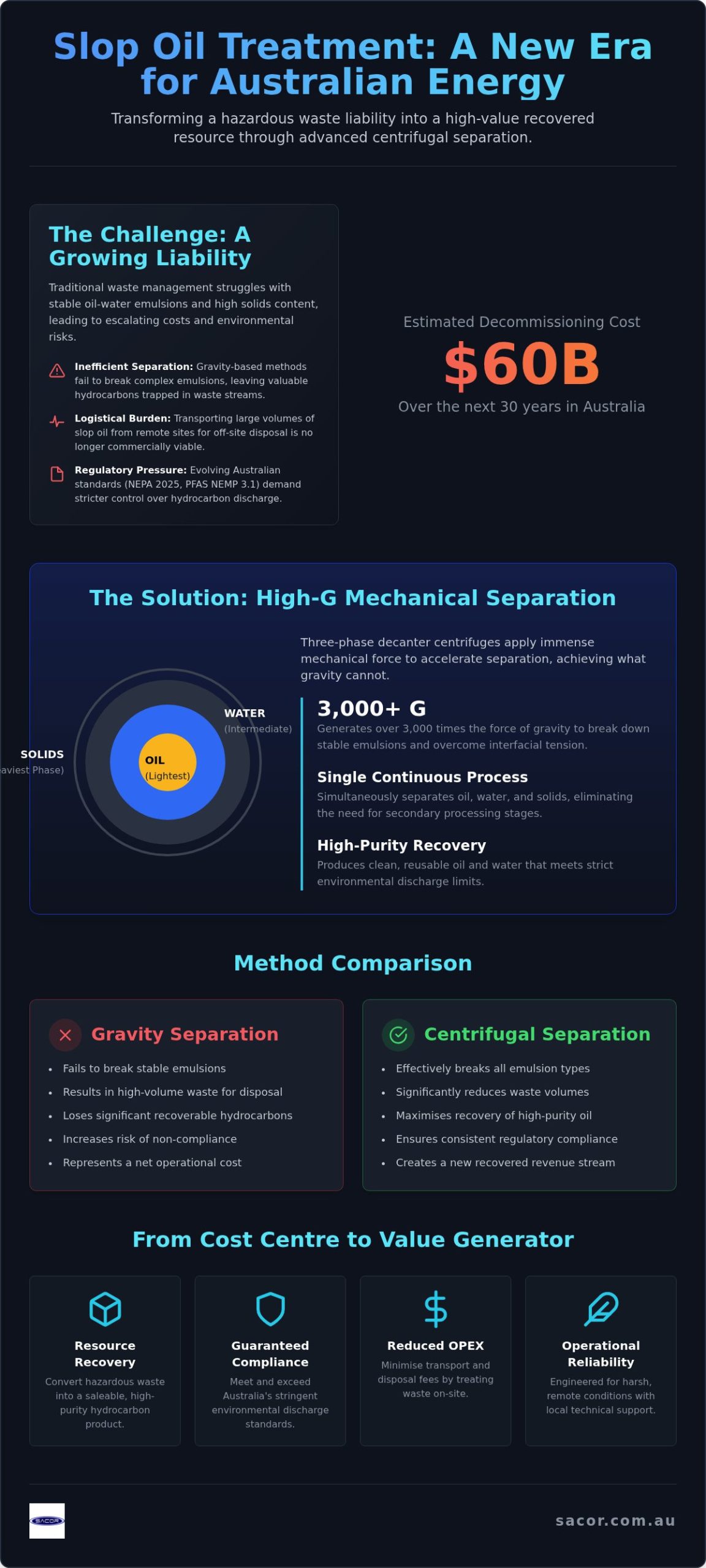
With an estimated $60 billion required for the decommissioning of offshore infrastructure over the next 30 years, the management of hazardous waste streams has moved from a peripheral operational concern to a core strategic priority for the Australian energy sector. Operators recognise that the logistical burden of transporting stable oil-water emulsions from remote sites for disposal is no longer commercially viable, especially as strict Australian regulations regarding hydrocarbon discharge continue to evolve. It’s a shift that demands technical precision. Implementing a high-performance slop oil treatment centrifuge Australia allows companies to address these challenges directly by recovering high-purity hydrocarbons for reuse while significantly reducing waste volumes. This authoritative guide serves as a technical resource for engineers and plant managers seeking to optimise their separation processes in alignment with the latest 2026 environmental standards. We provide a detailed analysis of three-phase decanter systems, explore the impact of recent legislative amendments on discharge limits, and outline the automated configurations necessary for consistent performance in harsh field conditions. By transitioning from waste disposal to resource recovery, facilities can achieve both regulatory compliance and improved operational margins through a methodical, technology-led approach.
Key Takeaways
- Understand why traditional gravity separation fails to meet modern Australian environmental standards and how high-G mechanical separation overcomes stable oil-water emulsions.
- Learn how to evaluate technical specifications, such as bowl speed and scroll configuration, to effectively manage high solids loading and produce high-purity recovered oil.
- Identify the critical steps for selecting a slop oil treatment centrifuge Australia by matching equipment throughput to site-specific waste generation rates and feed characteristics.
- Recognise the importance of local technical support and customised commissioning to ensure equipment reliability and minimal downtime in remote Australian oilfield operations.
- Discover how a partnership-based engineering approach transforms hazardous waste management from a significant operational cost into a sustainable recovered revenue stream.
Understanding Slop Oil Treatment in the Australian Energy Sector
In the context of Australian upstream and midstream operations, slop oil represents one of the most challenging waste streams to manage effectively. It’s defined as a complex, non-homogeneous mixture of oil, water, and inorganic solids that accumulates during drilling, production, and tank cleaning processes. Traditional gravity-based separation methods often prove inadequate for these streams because they lack the force required to break complex emulsions or remove fine particulate matter. For operators, the inability to treat these fluids on-site leads to escalating disposal costs and lost revenue from unrecovered hydrocarbons. Implementing a dedicated slop oil treatment centrifuge Australia provides a mechanical solution that accelerates phase separation, turning a hazardous liability into a refined, reusable resource. This technology is essential for maintaining operational momentum in remote locations where logistical constraints make waste transport prohibitively expensive.
The Composition of Oilfield Slop Oil
The specific makeup of slop oil depends on the source, whether it originates from Crude oil washing, wellbore cleanouts, or drainage systems. These fluids consist of varying ratios of free oil, oil-in-water emulsions, and heavy inorganic solids such as silt or barite. Stable emulsions are particularly problematic; the interfacial tension between oil and water droplets is often too strong for simple settling tanks to overcome. Across different Australian basins, site-specific variables like temperature and chemical additives further complicate these characteristics. High-performance centrifuges apply thousands of Gs of force to overcome these physical barriers, ensuring that solids and water are stripped from the hydrocarbon phase with high precision.
Regulatory Pressures and Environmental Responsibility
Australian energy companies operate under some of the world’s most stringent environmental frameworks, including the National Environmental Protection Agency Act 2025 and the updated PFAS National Environmental Management Plan 3.1 released in June 2026. Regulatory bodies demand high transparency regarding hydrocarbon discharge and the management of hazardous waste. On-site treatment using centrifugal technology significantly reduces the environmental footprint by minimising the volume of waste destined for off-site disposal. This approach aligns with the industry’s broader shift toward sustainable practice, where the goal is to close the loop on waste generation. By recovering high-purity oil for reuse or sale, facilities don’t just meet compliance targets; they improve their overall site ROI and demonstrate a commitment to responsible resource management.
Technical Specifications for Oilfield Centrifuge Separators
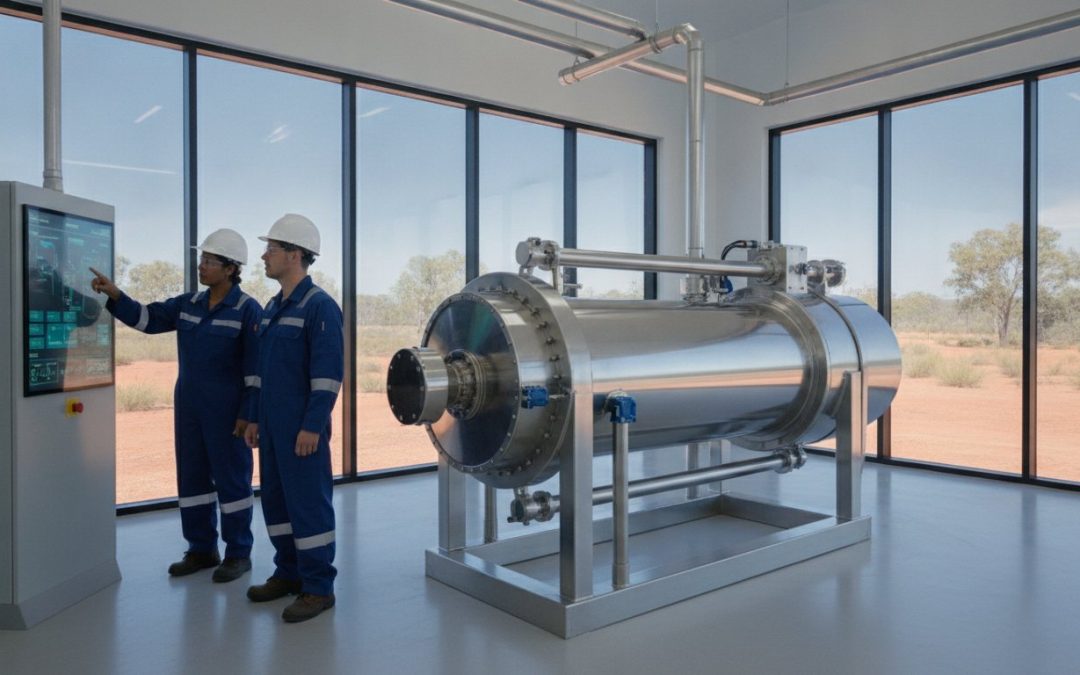
High-performance separation is dictated by the precise application of centrifugal force to accelerate the settling of phases with distinct densities. In a slop oil treatment centrifuge Australia, the bowl rotates at significant velocities to generate G-forces that can exceed 3,000 G. This mechanical force drives heavier inorganic solids toward the bowl wall, while the liquid phases arrange themselves into concentric layers. The differential speed between the bowl and the internal scroll then facilitates the continuous discharge of these separated components. It’s a process that requires robust engineering to maintain stability under the intense torque loads generated by high-solids feed.
Three-Phase vs. Two-Phase Separation Technology
Three-phase decanter centrifuges are specifically engineered to handle the complexity of slop oil by separating oil, water, and solids in a single continuous process. This configuration is superior for recovering high-value hydrocarbons directly from the feed without requiring secondary processing stages. Conversely, two-phase systems are typically reserved for primary dewatering or “roughing” duties where the objective is merely to reduce the volume of the water phase. For facilities targeting maximum oil clarity, a three-phase system provides the necessary precision to meet strict discharge limits. Selecting the correct Decanter Centrifuge System depends on the specific balance of emulsions and solids present in the site’s waste stream.
Bowl Geometry and Scroll Design
The internal architecture of the centrifuge significantly influences separation efficiency. A high length-to-diameter (L/D) ratio is essential for slop oil applications as it increases the residence time of the fluid within the bowl. This extended duration allows for the separation of even the most stubborn, stable emulsions that would otherwise remain unresolved. Scroll design must also account for the abrasive nature of oilfield solids like sand and barite. High-quality systems utilise tungsten carbide tiles or flame-sprayed hard-facing on the scroll flights to prevent premature wear. Adjustable weir plates further allow operators to fine-tune the depth of the liquid pond, which is critical for maintaining a sharp interface between the oil and water phases.
Robust construction materials, such as duplex stainless steel, ensure that the equipment remains operational in the corrosive and high-temperature environments typical of Australian energy sites. Integration with existing plant SCADA systems via PLC-based control panels allows for the automated monitoring of vibration, bearing temperature, and torque. These automated safeguards protect the capital investment while ensuring consistent output quality without constant manual intervention. By prioritising these technical specifications, operators can guarantee that their separation process remains reliable despite the unpredictable nature of oilfield waste.
Selecting the Right Centrifuge for Slop Oil Recovery
Selecting an optimal slop oil treatment centrifuge Australia requires a methodical evaluation of site-specific variables rather than a generic procurement approach. Engineers must first determine throughput requirements by matching the centrifuge’s processing capacity to the actual volume of waste generated during peak production cycles. Over-specifying leads to unnecessary capital expenditure; under-specifying creates operational bottlenecks that can halt production. Feed characteristics are rarely consistent across different basins, making laboratory analysis or on-site pilot testing essential to understand particle size distribution and emulsion stability. This technical rigour allows for the precise engineering of the bowl and scroll to handle the specific viscosity and solids loading of the site. Evaluating the total cost of ownership (TCO) is equally vital, as it forces a move beyond the initial purchase price to consider long-term maintenance cycles, spare parts availability, and energy efficiency in remote, high-cost environments.
Performance Indicators for Slop Oil Centrifuges
The success of a separation programme is measured by three primary Key Performance Indicators. Oil-in-water (OIW) levels must meet strict regulatory discharge standards, while water-in-oil (WIO) percentages determine the market value of recovered hydrocarbons. Additionally, solids cake dryness directly impacts transport logistics; producing a drier cake reduces waste volume and associated disposal fees at hazardous waste facilities. A well-configured system can realistically reclaim up to 98% of available hydrocarbons from stable slop streams, significantly improving the site’s overall return on investment by turning waste into a refined resource.
Customisation and Engineering for Site Specifics
Equipment reliability in the Australian energy sector depends on the ability to handle fluctuating feed qualities through customisable engineering. Advanced control systems allow operators to adjust differential speeds and pond depths in real-time, maintaining separation clarity even when slop oil composition shifts due to different production phases. Safety requirements are paramount; units destined for hazardous zones must carry appropriate explosion-proof (EXD) ratings to comply with Australian oilfield standards. Finalising integration requirements, such as the skid footprint, power consumption, and the placement of auxiliary polymer dosing units, ensures the system fits within existing plant constraints. For a deeper technical analysis of equipment categories and broader selection frameworks, refer to our industrial decanter centrifuge Australia guide.
Operational Logistics and Maintenance in Remote Australian Sites
Ensuring the long-term reliability of a slop oil treatment centrifuge Australia requires a logistical strategy that accounts for the extreme isolation of many energy assets. Equipment downtime in regions like the Surat or Carnarvon basins isn’t just an inconvenience; it’s a significant financial drain. Local technical support is non-negotiable for minimising these interruptions. Sacor’s approach to commissioning goes beyond basic installation. Our engineers ensure that every system is calibrated for the specific feed characteristics identified during the initial site analysis, providing peak performance from the first hour of operation. This day-one optimisation is vital for meeting production targets without delay.
Dusty and saline environments in the Australian outback accelerate wear on high-speed rotating equipment. Rigorous preventative maintenance schedules are essential to protect these high-capital assets. This includes regular vibration analysis, lubrication checks, and seal inspections to prevent catastrophic failure. Empowering site personnel through structured training is equally critical. When operators understand the nuances of centrifuge performance, they can make real-time adjustments that maintain separation clarity even as feed conditions fluctuate. This proactive approach ensures that the equipment remains a reliable part of the site’s infrastructure for its entire service life.
Spare Parts Availability and National Support
Relying on international supply chains for critical components introduces unacceptable risks to project timelines. A delay in receiving a specific bearing or scroll tile can lead to weeks of operational stagnation. We maintain a robust national inventory of critical spare parts to ensure rapid dispatch across the country. This physical presence is complemented by remote monitoring capabilities. Technical troubleshooting can often be initiated via secure data links, allowing our specialists to assist site teams with diagnostics and adjustments without the delays associated with travel to remote regions.
Lifecycle Management and Technical Audits
Performance naturally drifts over time as site conditions and feed qualities shift. Regular technical audits are necessary to verify that separation efficiency remains within specified tolerances. These audits provide a clear roadmap for refurbishment or technical upgrades, extending the operational life of the equipment. Similar maintenance rigour is required for related streams, such as those discussed in our guide on produced water treatment centrifuge technology. Maintaining a consistent standard across all separation assets ensures a unified approach to waste management and compliance. If your facility requires a tailored maintenance contract or a technical audit of existing equipment, contact our team to discuss our Maintenance and Technical Support Services.
Sacor: Customised Centrifugal Separation Solutions for Australia
Sacor occupies a position of quiet assurance as a leading technical authority in the Australian centrifugal separation landscape. We’ve built our reputation on a steady, grounded conviction that high-performance technology must be matched by deep domain expertise. Our work across the mining, energy, and wastewater sectors has proven that a one-size-fits-all approach is insufficient for the complexities of modern industrial waste. By positioning ourselves as a trusted partner rather than a mere vendor, we work alongside clients to design bespoke systems that directly address their unique feed characteristics and operational goals. This collaborative framing ensures that every slop oil treatment centrifuge Australia we supply is a precision-engineered asset designed to reduce both environmental impact and long-term operational costs.
Why Partner with an Australian Specialist?
Operating within the Australian energy sector requires an intimate understanding of a unique regulatory and geographic landscape. National standards for hydrocarbon management are increasingly stringent; the logistical challenges of remote sites demand equipment that is both robust and easily supported. Partnering with a specialist like Sacor provides direct access to experienced engineers who understand these pressures first-hand. We provide customised solutions for complex separation challenges, ensuring that our three-phase centrifuge systems are configured to meet local EPA requirements. This approach supports local industry while providing Australian operators with world-class decanter technology that has been proven in the field.
Getting Started with Your Slop Oil Project
The transition from a waste liability to a recovered revenue stream begins with a thorough process evaluation. We initiate every project with a detailed consultation to establish the baseline requirements of the site, including throughput targets and desired output purity. Our engineering team then conducts a technical analysis of feed samples to determine the precise particle size distribution and emulsion stability of the slop oil. This data-driven phase is critical for accurate system sizing and ensures that the final equipment configuration is optimised for the site’s specific conditions. It’s a methodical progression. This builds confidence in the final outcome, ensuring that the capital investment delivers consistent, reliable results from commissioning through to the end of the asset’s lifecycle. Contact Sacor for a technical consultation on your slop oil treatment needs to begin the process of optimising your site’s separation efficiency.
Advancing Operational Efficiency and Environmental Stewardship
The transition from managing slop oil as a hazardous liability to treating it as a valuable recovered resource is a strategic necessity in the current energy landscape. Implementing a high-performance slop oil treatment centrifuge Australia allows operators to resolve stable emulsions and remove fine solids with a level of precision that gravity-based systems simply cannot match. This technical approach doesn’t just satisfy 2026 regulatory standards; it directly improves site ROI by reclaiming high-purity hydrocarbons for reuse. Success in remote Australian basins depends on equipment that’s engineered for harsh conditions and supported by a robust national maintenance network. By prioritising bespoke design and local technical expertise, facilities can ensure consistent performance and minimal downtime. Sacor stands as an Australian-owned and operated technical authority, providing the engineering rigour and spare parts support necessary to protect your capital investment. We invite you to consult with our specialist engineers about your oilfield centrifuge requirements and discover how a partnership-based approach can transform your separation processes. Achieving a sustainable, circular waste management strategy is within reach with the right technology and technical partner.
Frequently Asked Questions
What is the difference between a 2-phase and 3-phase centrifuge for slop oil?
A three-phase centrifuge separates oil, water, and solids simultaneously in one continuous process. It’s the standard for slop oil treatment because it recovers high-purity hydrocarbons while discharging clean water and dry solids. Two-phase systems only separate liquids from solids or two liquids from each other. For complex slop streams, the three-phase configuration is essential to achieve the separation clarity required for reuse or sale.
Can a centrifuge handle stable oil-water emulsions without chemicals?
High-G mechanical force can often break moderately stable emulsions by exploiting the density differences between the phases. However, for highly stable emulsions common in oilfield slops, chemical demulsifiers are often integrated into the feed line to accelerate the process. A slop oil treatment centrifuge Australia provides the necessary mechanical energy to ensure that once these chemical bonds are weakened, the phases separate completely and consistently.
How much oil can be recovered from oilfield slop oil using a centrifuge?
Modern decanter systems can realistically reclaim up to 98% of the available hydrocarbons from a typical slop stream. The exact recovery rate depends on the initial oil concentration and the stability of the emulsions present. By utilising high centrifugal force, operators can transform a hazardous waste stream into a refined product that meets pipeline or refinery specifications, significantly improving the site’s overall resource recovery metrics.
What are the maintenance requirements for a decanter centrifuge on a remote site?
Maintenance focuses on protecting high-speed rotating components through regular lubrication, vibration monitoring, and seal inspections. In harsh Australian environments, it’s also critical to inspect the scroll flights for abrasive wear caused by sand or barite. We recommend a structured preventative schedule to identify potential issues before they lead to downtime. Having a local partner ensures that technical support and specialised tooling are accessible when these scheduled intervals occur.
How does centrifugal separation compare to traditional oil-water separators?
Traditional separators rely on gravity and residence time, which often proves insufficient for the stable emulsions and fine solids found in slop oil. Centrifuges use mechanical energy to generate G-forces thousands of times stronger than gravity. This results in much faster processing times, a smaller equipment footprint, and significantly higher separation efficiency. Centrifugal technology is the superior choice for meeting the strict discharge limits mandated by Australian environmental regulators.
What safety ratings are required for centrifuges in Australian oilfield environments?
Centrifuges operating in hazardous zones must carry appropriate explosion-proof ratings, typically referred to as EXD or Ex d. These ratings ensure that all electrical components and enclosures are designed to contain any internal explosion and prevent the ignition of flammable gases in the surrounding atmosphere. Compliance with these Australian standards is a non-negotiable requirement for equipment destined for upstream production sites or refineries where volatile hydrocarbons are present.
Does Sacor provide on-site commissioning and operator training in Australia?
We provide comprehensive on-site commissioning to ensure every system is optimised for the specific feed characteristics of your facility. Following installation, our engineers conduct structured training sessions for site personnel. This training empowers operators to manage the centrifuge effectively, covering real-time adjustments, routine maintenance, and troubleshooting. This partnership approach ensures that your team has the technical confidence to maintain peak separation performance from day one.
Are spare parts for decanter centrifuges readily available in Australia?
We maintain a robust inventory of critical spare parts within Australia to support our clients’ national operations. Relying on international supply chains for bearings, seals, or scroll tiles introduces unnecessary risks to project timelines. Our local warehousing ensures that essential components can be dispatched rapidly to remote sites, minimising the risk of prolonged equipment downtime. This commitment to local availability is a core part of our reliability promise.