
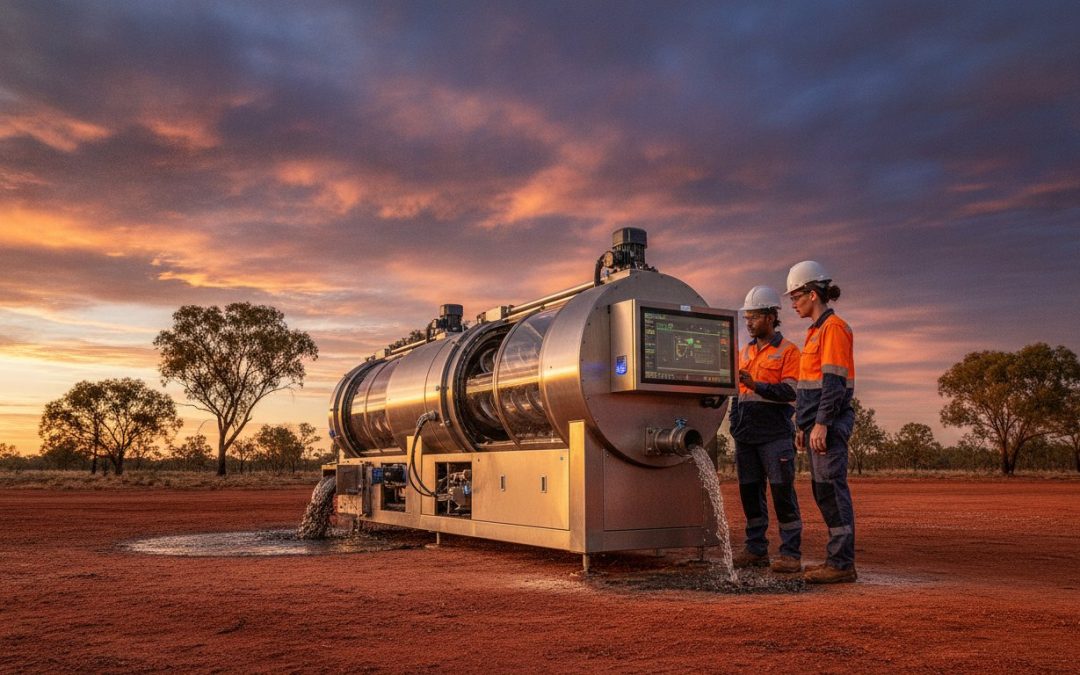
In remote Australian drilling operations, the logistical burden of transporting weighting agents often outweighs the procurement cost of the material itself. You likely recognise that maintaining high-density mud systems while managing the build-up of harmful ultra-fine solids is a relentless challenge that often leads to centrifuge blockages and compromised fluid integrity. Efficiently managing a barite recovery centrifuge Australia is no longer just a technical preference but a strategic necessity to offset rising operational expenses and resource waste.
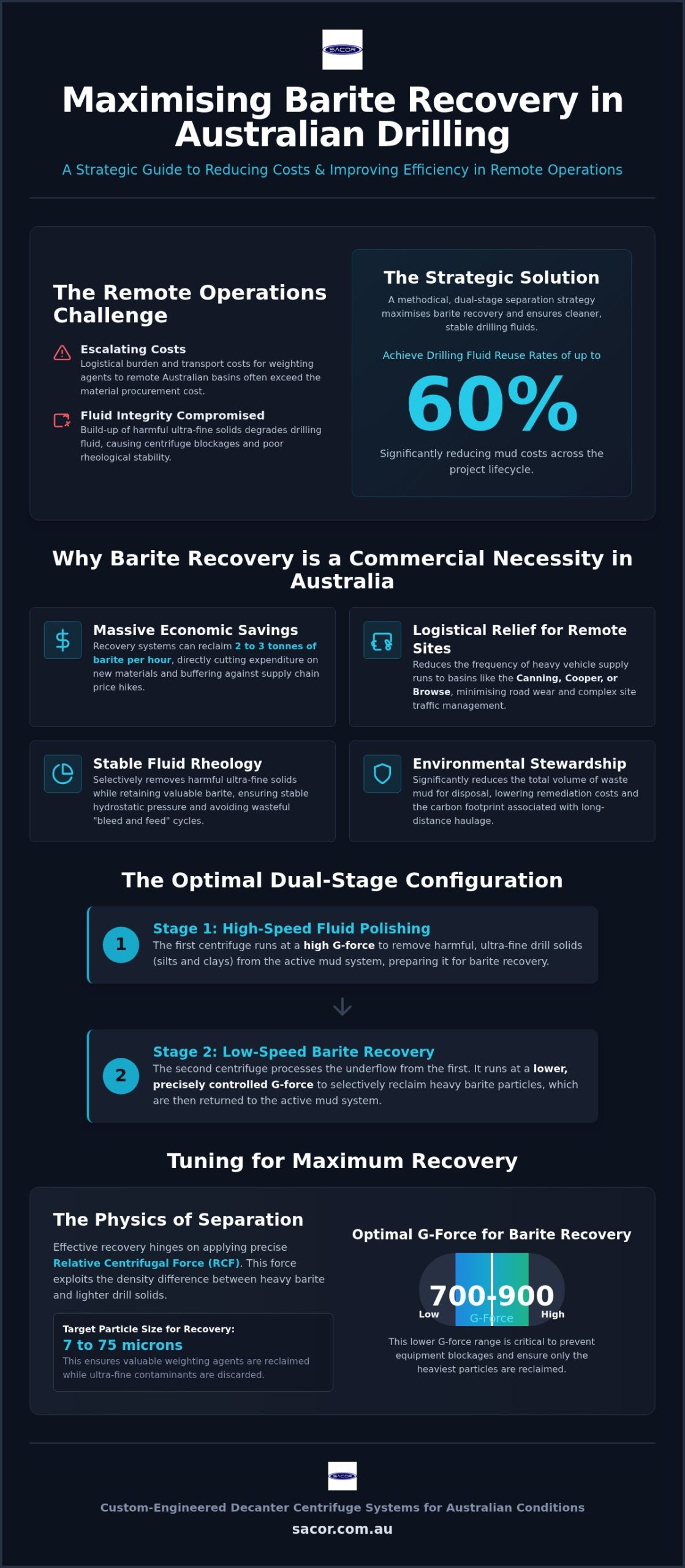
We will demonstrate the precise technical processes and operational configurations required to maximise barite recovery and significantly reduce mud costs across your project lifecycle. By implementing a methodical, dual-stage separation strategy, operators can achieve drilling fluid reuse rates of up to 60 per cent, ensuring cleaner fluids with stable rheological properties. This article provides a comprehensive overview of centrifuge tuning, feed rate optimisation, and the maintenance protocols essential for ensuring equipment uptime in the most demanding Australian environments.
Key Takeaways
- Understand why reclaiming barite is a commercial necessity for remote Australian drilling basins to offset the high costs of procurement and transport.
- Learn how to apply the principles of Stokes’ Law and Relative Centrifugal Force to effectively separate heavy weighting agents from the liquid phase.
- Discover why a dual-stage barite recovery centrifuge Australia configuration is essential for balancing high-speed fluid polishing with efficient solids reclamation.
- Identify the specific operational parameters, including maintaining a G-force between 700 and 900, required to maximise recovery while preventing equipment blockages.
- Explore how custom-engineered decanter centrifuge systems can be tailored to specific Australian feed characteristics to improve both sustainability and equipment uptime.
Why Barite Recovery is Essential for Australian Drilling Economics
Barite recovery is the technical process of using centrifugal force to reclaim heavy weighting agents from drilling mud before they are lost to the waste pit. By utilising a barite recovery centrifuge Australia, operators can effectively separate high-density solids from the active mud system, allowing the reclaimed material to be recirculated into the suction tank. This process is particularly critical when dealing with weighted mud systems where the cost of the weighting agent represents a substantial portion of the daily mud budget.
The economic incentive for recovery is amplified by the extreme logistical challenges found in Australian basins such as the Canning, Cooper, or Browse. Transporting bulk materials to these remote locations involves significant haulage costs and complex supply chain coordination. When a system is capable of recovering 2 to 3 tonnes of barite per hour, the reduction in total project expenditure becomes undeniable. This efficiency directly decreases the volume of new material required on-site, providing a buffer against supply chain disruptions and escalating transport fees.
The Role of Barite in Drilling Fluid Rheology
Maintaining precise hydrostatic pressure is fundamental to wellbore stability and the prevention of unplanned influxes. Because of its high specific gravity and chemical inertness, industry professionals prefer barite as a weighting agent for Australian high-pressure wells. However, the continuous build-up of ultra-fine drill solids can degrade fluid properties. Recovery systems allow for the selective removal of these harmful fines while retaining the valuable barite, ensuring that the rheological profile remains stable without the constant need for “bleed and feed” operations that waste expensive chemicals.
Logistical Advantages for Remote Australian Sites
Operating a high-performance barite recovery centrifuge Australia provides immediate logistical relief by reducing the frequency of heavy vehicle supply runs. Minimising the number of road trains required to service a remote site lessens the wear on private access roads and reduces the complexity of site traffic management. Effective recovery also reduces the requirement for large-scale bulk storage on-site. This creates a more compact operational footprint and enhances site independence, allowing drilling programmes to continue even when weather events or road closures restrict access to external supplies.
Environmental stewardship also plays a central role in modern Australian drilling standards. By reclaiming barite, companies significantly reduce the total volume of waste mud destined for disposal. This reduces landfill or remediation costs and lowers the carbon footprint associated with long-distance haulage. Integrating these recovery systems reflects a commitment to sustainable industrial practice, aligning operational efficiency with environmental responsibility.
The Technical Mechanics of Barite Separation in Centrifuges
Effective barite recovery relies on the precise application of mechanical force to exploit the density differential between weighting agents and the base fluid. A high-performance barite recovery centrifuge Australia operates by rotating a cylindrical bowl at high speeds, generating centrifugal forces that accelerate the settling rate of suspended solids. While standard solids control focuses on removing all contaminants, barite recovery is a selective process. It targets a specific particle size range, typically between 7 and 75 microns, to ensure the heavy barite is reclaimed while ultra-fine silts and clays remain in the liquid phase for subsequent removal.
The efficiency of this separation is governed by the physical properties of the slurry. Because barite has a high specific gravity, it settles much faster than lighter drill solids of the same size. By precisely controlling the centrifugal force, operators can ensure that only the heavier barite particles reach the bowl wall before the fluid exits the system. This allows for the continuous reclamation of weighting material without the risk of over-processing the mud and losing valuable chemical additives.
RCF and Bowl Speed Dynamics
Relative Centrifugal Force (RCF) is the “G-force” that drives the separation process. For successful barite recovery, the centrifuge is typically tuned to a lower G-force than a standard polishing unit, usually ranging between 700 and 900 Gs. This lower force prevents the ultra-fine harmful solids from settling alongside the barite. In 2026, Stokes’ Law remains the fundamental governing principle for barite recovery, stating that the settling velocity of a particle is directly proportional to the square of its diameter and the difference in density between the particle and the fluid medium. Calculating the required G-force involves balancing bowl diameter with rotational speed; larger diameter bowls can achieve the necessary RCF at lower RPMs, which reduces mechanical wear. Adhering to these technical standards is a core component of responsible Australian drilling waste management, as it ensures the fluid remains viable for longer periods.
The Importance of Conveyor Differential
Inside the bowl, an internal screw conveyor rotates at a slightly different speed to the bowl itself. This differential speed is critical. It determines the residence time of the solids and dictates how quickly the recovered barite cake is moved toward the discharge ports. When processing high-density muds, managing this differential prevents “plugging” or blockages that can lead to costly downtime. Operators must balance torque limits with recovery efficiency to ensure a dry, high-quality barite discharge. If your site requires a more granular approach to fluid management, exploring customised decanter centrifuge systems can provide the precision needed for complex Australian geological formations.
Designing a Dual-Stage Centrifuge Configuration for Mud Systems
Implementing a series configuration is the established benchmark for managing weighted mud systems in Australian drilling operations. While a single unit can perform basic solids control, a dual-stage arrangement is required to selectively reclaim weighting agents without retaining the colloidal fines that degrade fluid quality. This methodical approach ensures that the barite recovery centrifuge Australia functions as a precision instrument within the wider circulation system, rather than a blunt filtration tool. By placing two decanters in series, operators can achieve a level of fluid clarity and cost efficiency that parallel operations simply cannot match.
This configuration is particularly vital for meeting the stricter environmental requirements outlined in the 2026 PFAS National Environmental Management Plan (NEMP) 3.1. Reducing waste volumes isn’t just about cost; it’s about compliance. A well-designed dual-stage system minimises the total volume of slurry destined for disposal, directly impacting the bottom line when navigating high landfill levies in states like New South Wales.
The Medium-Speed Recovery Unit
The first stage of the process involves a medium-speed decanter centrifuge dedicated specifically to barite reclamation. Operating typically between 1800 and 2200 RPM, this unit targets a force of 700 to 800Gs. This specific range is high enough to settle the heavy barite particles while allowing the lighter, harmful ultra-fine solids to remain suspended in the liquid overflow. The “clean” barite is then discharged as a heavy paste and routed back to the suction tank. For a deeper look at how specialised hardware facilitates this, our guide on energy sector centrifuge equipment details the technical specifications required for modern Australian basins.
The High-Speed Polishing Unit
Once the barite has been reclaimed, the remaining fluid is fed into a second, high-speed “polishing” unit. This centrifuge operates at speeds exceeding 3000 RPM to generate the higher G-forces necessary to strip out particles as small as 2 to 5 microns. Removing these colloidal solids is essential for maintaining the plastic viscosity and gel strength of the mud. Without this second stage, these fines would build up in the active system, eventually requiring the operator to dilute the mud with expensive base fluids. The harmful cuttings captured here are discharged to the waste management system, ensuring the active mud remains lean and responsive.
Managing the return of recovered barite requires careful integration with the site’s jet-hopper. It’s not enough to simply dump the reclaimed solids back into a tank; they must be properly dispersed to prevent settling or “slugging” of the mud system. Ensuring a consistent, well-mixed return path maintains the targeted mud weight across the entire hole section. This dual-stage configuration, when executed correctly, provides the operational resilience needed for the most challenging remote Australian drilling programmes. For operations that also generate hydrocarbon-laden waste streams alongside drilling fluids, understanding how a slop oil treatment centrifuge Australia integrates into a broader waste management strategy can further reduce disposal costs and regulatory exposure.
How to Tune Your Centrifuge Parameters for Maximum Barite Recovery
Tuning a barite recovery centrifuge Australia is a methodical process that begins with a clear understanding of your mud’s current rheological state. You can’t achieve peak efficiency without first determining the exact mud density and your target recovery rate. Once these benchmarks are established, you’ll need to follow a structured sequence of adjustments to ensure the equipment performs reliably under the specific conditions of your wellbore.
- Set the Bowl Speed: Adjust the rotational speed to achieve a Relative Centrifugal Force (RCF) between 700 and 900 Gs. This range is the industry standard for recovery because it’s sufficient to settle heavy barite while keeping lighter, harmful fines in suspension.
- Adjust the Feed Rate: Set your feed pump to match the centrifuge’s rated processing capacity. Flooding the bowl leads to turbulence, which disrupts the settling of barite and results in valuable material being lost to the effluent.
- Fine-tune the Differential: Modify the conveyor speed relative to the bowl speed. A well-tuned differential ensures the recovered barite cake is dry and handleable as it exits the discharge ports.
- Monitor the Centrate: Regularly inspect the liquid discharge for barite carry-over. If you see heavy solids in the effluent, it’s a clear signal that your G-force is too low or your feed rate is too high.
Managing Feed Rate and Dilution
In many Australian drilling scenarios, adding a small, controlled volume of water or thin mud to the centrifuge feed can actually improve recovery rates. This occurs because dilution reduces the plastic viscosity of the slurry, allowing the heavy barite particles to move more freely toward the bowl wall. Finding the “sweet spot” involves balancing this throughput with the clarity of the centrate. We recommend using electromagnetic flow meters to maintain a consistent feed volume, as even minor fluctuations can destabilise the separation process and lead to inconsistent mud weights in the suction tank.
Troubleshooting Common Recovery Issues
If the barite cake appears “sloppy” or excessively wet, it’s often a sign that the solids have a short residence time or the differential speed is too high. Conversely, high vibration levels usually indicate an uneven build-up of barite within the bowl, often caused by inconsistent feed density. You should also ensure your jet-hopper is optimised to prevent the clumping of recovered solids. If you’re encountering persistent operational challenges, our team provides maintenance and technical support services to help you calibrate your system for maximum reliability on remote sites.
Partnering with Sacor for Australian Centrifuge Solutions and Support
Sacor operates as a seasoned technical authority within the Australian energy and mining sectors, providing a depth of expertise that extends far beyond simple equipment supply. We recognise that a barite recovery centrifuge Australia must perform reliably in the most unforgiving outback environments while delivering the precision required for complex fluid systems. Our brand is built on a foundation of quiet assurance and a results-focused methodology. We ensure every decanter system we deploy contributes to your operational efficiency and your environmental sustainability goals. Partnering with a local specialist means you gain access to responsive support that overseas manufacturers can’t provide. We position ourselves as a trusted, experienced partner rather than a vendor pitching a product, allowing us to build long-term relationships based on competence and reliability.
Bespoke Engineering and Design Services
Every drilling project presents unique geological challenges. This requires fluid management systems tailored to specific feed characteristics. Sacor’s engineering team collaborates directly with site managers to integrate our technology into existing mud tank architectures, ensuring seamless fluid flow and optimal recovery. Our designs are prioritised for robustness to handle the high temperatures and abrasive materials common in remote basins. For a deeper understanding of our technical capabilities, you can explore our industrial decanter centrifuge Australia guide. This level of customisation is essential for meeting the strict requirements of the PFAS National Environmental Management Plan (NEMP) 3.1, helping you manage contaminants while reclaiming valuable resources from the mud system.
Maintenance and Technical Support
Reliability is the cornerstone of any remote drilling operation. Equipment downtime can lead to significant financial losses, so we provide comprehensive lifecycle support ranging from on-site commissioning to long-term maintenance contracts. We maintain a substantial inventory of spare parts ready for rapid deployment across the country. This ensures that your barite recovery centrifuge Australia remains operational regardless of your site’s isolation. Beyond hardware, we offer technical training for on-site mud technicians, empowering your team to monitor performance and adjust parameters with confidence. As a trusted Australian-owned partner, our steady approach ensures that your operation meets its performance targets while adhering to the latest Australian reporting standards and waste regulations.
Advancing Your Drilling Fluid Efficiency
Optimising your drilling operation in remote Australian basins requires a methodical approach to resource reclamation. We’ve established that the logistical burden of barite procurement can be significantly mitigated through a precision-tuned, dual-stage separation process. By maintaining a Relative Centrifugal Force between 700 and 900 Gs, you can reclaim valuable weighting agents while simultaneously stripping out harmful colloidal fines that degrade fluid rheology. This balance is critical for maintaining wellbore stability and reducing total project expenditure. Integrating a high-performance barite recovery centrifuge Australia into your mud system isn’t just an operational preference; it’s a strategic move towards technical resilience and environmental responsibility.
As an Australian-owned and operated specialist, Sacor provides the engineering expertise and lifecycle support necessary to keep your equipment running in the harshest conditions. From bespoke design to comprehensive maintenance and rapid spare parts supply, we work alongside you to ensure your performance targets are met. Contact Sacor today to discuss a customised barite recovery solution for your drilling operation. We look forward to helping you achieve greater independence and efficiency on your next project.
Frequently Asked Questions
What is the primary function of a barite recovery centrifuge?
The primary function of a barite recovery centrifuge Australia is to selectively separate heavy weighting agents from the drilling mud so they can be returned to the active system. By applying controlled centrifugal force, the unit isolates barite particles based on their high specific gravity. This process allows operators to reclaim expensive materials while simultaneously removing lighter, harmful ultra-fine solids in a secondary stage, ensuring the mud maintains its required density and rheological properties.
How much barite can typically be recovered per hour?
Modern decanter systems operating in Australian basins can typically recover between 2 and 3 tonnes of barite per hour. The exact volume depends on the mud density, the feed rate, and the centrifuge’s bowl diameter. Maintaining this recovery rate is essential for reducing the logistical burden of transporting bulk weighting agents to remote sites. High-performance units ensure that a significant portion of the barite remains in the active system rather than being lost to waste.
Can a single centrifuge handle both barite recovery and fine solids removal?
A single centrifuge cannot effectively handle both barite recovery and fine solids removal simultaneously because each process requires different operational parameters. Recovery units operate at lower G-forces to capture heavy barite without settling fine contaminants. Conversely, removing ultra-fines requires much higher rotational speeds. Attempting both with one machine results in either poor recovery or the retention of harmful solids, which is why a dual-stage configuration is the preferred industry standard.
Does recovering barite affect the chemical properties of the drilling mud?
Recovering barite generally doesn’t alter the fundamental chemical properties of the mud, but it does help maintain stable rheology by preventing the build-up of colloidal solids. Because these units selectively reclaim weighting agents, they reduce the need for constant dilution and chemical additions. This stability ensures that the fluid’s plastic viscosity and gel strengths remain within project specifications, allowing for more predictable wellbore performance and a reduction in the total volume of expensive additives required.
What are the main causes of centrifuge plugging in weighted mud systems?
Centrifuge plugging in weighted mud systems is often caused by an excessive feed rate or an incorrectly set conveyor differential speed. When the volume of solids entering the bowl exceeds the conveyor’s discharge capacity, the barite cake builds up and eventually blocks the ports. Other factors include inconsistent mud density and the presence of large debris. Maintaining a steady feed and regularly monitoring torque levels are essential steps to prevent these costly operational interruptions.
How do I calculate the ROI for installing a barite recovery system?
Calculating the ROI for a barite recovery system involves comparing the cost of the equipment and its operation against the total savings in material procurement and haulage. You should account for the reduced volume of barite required per well, lower waste disposal fees, and decreased transport costs to remote basins. In many Australian operations, the ability to reuse 40 to 60 per cent of the drilling fluid leads to a rapid return on investment through significant mud cost reductions.
Is barite recovery suitable for both water-based and oil-based muds?
Barite recovery is highly suitable for both water-based and oil-based mud systems. In oil-based or synthetic-based fluids, the economic incentive is even higher because the base fluids themselves are more expensive to replace. Using a barite recovery centrifuge Australia ensures that the most costly components of the mud system are reclaimed and recirculated. This versatility allows operators to maintain high-performance fluid standards across various geological formations while adhering to strict environmental and waste management regulations. Sites managing oil-based mud systems may also benefit from reviewing the technical considerations around oilfield slop oil treatment centrifuge Australia processes to address the hydrocarbon-laden waste streams that often accompany these operations.
What maintenance is required for a centrifuge operating in high-density mud?
Operating in high-density mud requires a rigorous maintenance schedule to prevent abrasive wear on the bowl and conveyor. Key tasks include regular lubrication of the main bearings, inspecting the tungsten carbide tiles for erosion, and monitoring vibration levels. You should also perform routine flushes after every shift to prevent barite from settling and hardening inside the machine. Sacor provides full technical documentation and maintenance contracts to ensure equipment reliability and longevity in demanding Australian conditions.