Relying on traditional gravity settling in the modern Australian energy sector isn’t just inefficient; it’s a direct threat to your operational bottom line and reservoir longevity. You’re likely familiar with the mounting pressure to meet stringent BS&W standards while managing the escalating costs of water disposal in remote, high-stakes environments. The risk of plugging an injection well or facing regulatory penalties for non-compliance is a constant concern for engineers and plant managers across the country. This guide explores how an advanced produced water treatment centrifuge optimises separation efficiency, ensuring your operations remain both compliant and cost-effective.
By implementing precision centrifugal technology, you can protect the long-term permeability of your reservoirs and significantly reduce the volume of waste requiring transport or treatment. We’ll examine the specific technical advantages of three-phase separation, the impact on environmental stewardship, and how local Australian engineering support ensures these systems withstand the rigours of the field. This overview provides the technical clarity needed to transform produced water from a waste liability into a manageable, optimised resource.
Key Takeaways
- Understand how a produced water treatment centrifuge utilises high g-force to separate fine particles and oil droplets, ensuring consistent water quality for disposal or reuse.
- Discover the critical role of advanced separation in protecting injection well permeability and extending the operational lifespan of your energy assets.
- Learn to meet stringent Australian environmental regulations and BS&W standards while reducing the high costs associated with traditional water disposal volumes.
- Identify the strategic differences between two-phase and three-phase centrifugal systems to determine the most efficient configuration for your site’s specific throughput requirements.
- Explore the benefits of partnering with a national technical specialist for customised engineering and local spare parts supply to maintain reliability in remote Australian operations.
Understanding the Challenges of Produced Water in Energy Production
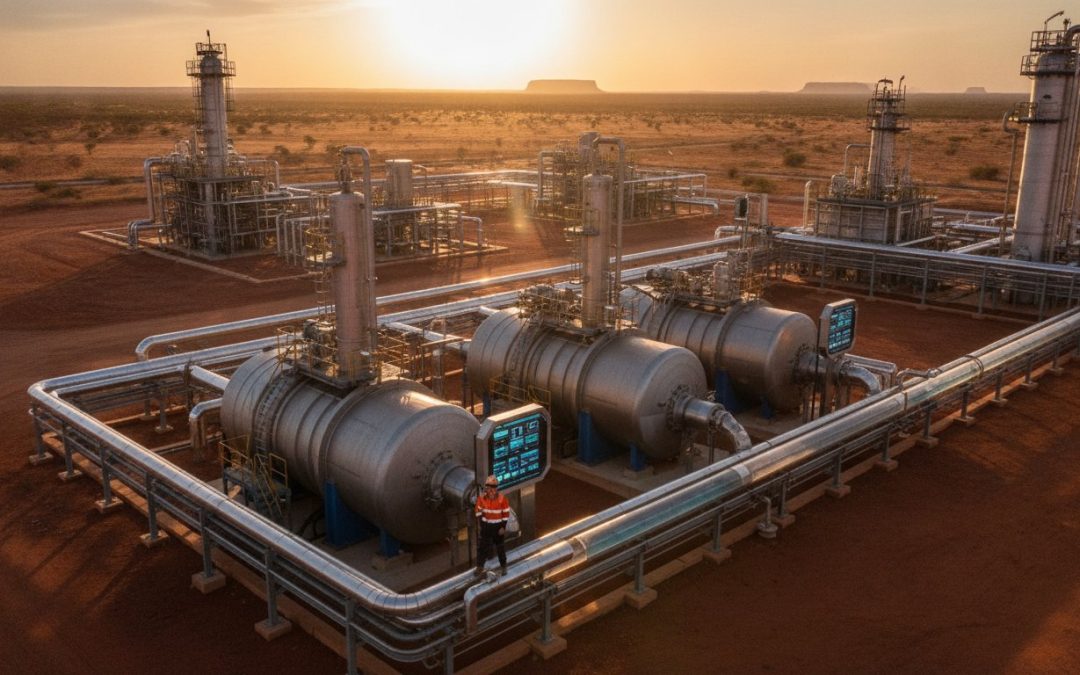
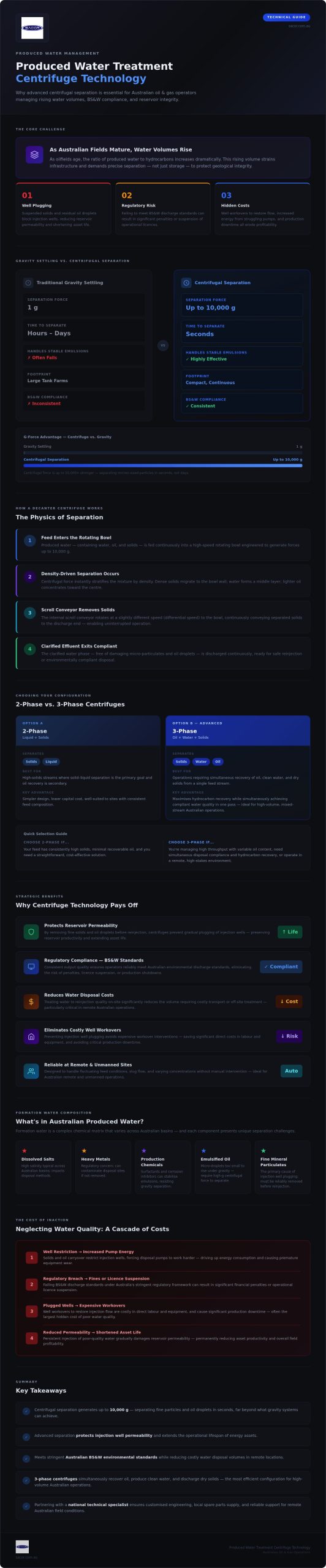
Produced water represents the most significant volume sidestream in oil and gas extraction. As Australian fields mature, the ratio of water to hydrocarbons often rises, which places immense pressure on existing infrastructure. Managing this volume requires more than simple storage; it demands precise separation to ensure that water destined for reinjection or disposal doesn’t compromise the geological integrity of the site. High concentrations of suspended solids and residual oil droplets can quickly lead to the plugging of injection wells, reducing reservoir permeability and shortening asset life. While traditional gravity settling tanks were once the industry standard, they often struggle to achieve the Basic Sediment and Water (BS&W) standards required in contemporary operations. The inability of gravity-based systems to handle high-volume, high-velocity streams makes the transition to advanced mechanical separation essential.
Composition and Characteristics of Formation Water
Formation water is a complex chemical matrix that varies significantly across different Australian basins. It typically contains dissolved salts, heavy metals, and various production chemicals alongside emulsified oil and fine mineral particulates. The presence of these stable emulsions is particularly problematic because the oil droplets are often too small to rise to the surface within a practical timeframe. The specific characteristics of the feed dictate the necessity of a produced water treatment centrifuge. These systems provide the accelerated sedimentation required to overcome the stability of emulsions that traditional tanks can’t handle. By applying high centrifugal force, operators can effectively remove microscopic solids and oil droplets, ensuring that the final effluent is clear of damaging contaminants before it reaches the injection point.
The Cost of Poor Water Quality
Neglecting water quality leads to a cascade of operational expenses and technical risks. When injection wells become restricted by solids or oil carryover, disposal pumps must work harder, leading to increased energy consumption and premature equipment wear. This mechanical strain is only part of the problem. Australian operators must navigate a stringent regulatory landscape where environmental compliance is non-negotiable. Failure to meet discharge standards can result in significant penalties or the suspension of operational licences. Perhaps the most substantial hidden cost is the frequent need for injection well workovers to restore flow. These interventions are not only expensive in terms of direct labour and equipment but also cause significant production downtime. Investing in a robust produced water treatment centrifuge is a strategic move to protect the long-term viability of the reservoir and the overall profitability of the asset.
How Centrifugal Force Optimises Produced Water Quality
Accelerated sedimentation is the core principle that allows a produced water treatment centrifuge to outperform traditional separation systems. While gravity settling relies on the density difference between oil, water, and solids over hours or days, centrifugal technology amplifies these forces by several orders of magnitude. Modern systems can generate g-forces up to 10,000 g, which effectively forces the separation of even the finest mineral particulates and micron-sized oil droplets. This high-intensity environment ensures that separation occurs in seconds rather than days, enabling continuous processing of high-volume streams without the massive footprint of traditional tank farms.
Robustness is a key requirement in Australian energy operations. Centrifuge designs are specifically engineered to handle significant fluctuations in feed solids and oil concentrations without requiring manual intervention. This adaptability is crucial when dealing with varying well outputs or slug flow conditions. The ability to maintain consistent output quality despite inconsistent input makes centrifugal separation the preferred choice for remote and unmanned sites.
The Physics of Separation in a Decanter Centrifuge
The mechanical efficiency of a decanter centrifuge relies on the precise relationship between the rotating bowl and the internal scroll conveyor. These components rotate at slightly different speeds, a characteristic known as the differential speed. This allows the bowl to capture solids against its wall while the scroll continuously moves them toward the discharge ports. Optimising the residence time within the bowl is critical; it ensures that the liquid phase has sufficient exposure to centrifugal force for maximum oil-water separation. To maintain a high-quality discharge, many modern designs incorporate centripetal pumps. These pumps use the kinetic energy of the rotating liquid to discharge the clarified phases under pressure, preventing foaming and reducing the risk of re-emulsification.
Disk Stack vs. Decanter Centrifuges
Choosing the right technology depends on the specific solids loading and the required clarity of the effluent. Decanter centrifuges are the primary workhorses for streams with high solids content, providing reliable bulk separation and dewatering. In contrast, disk stack separators are often employed for polishing stages. Their internal stack of conical disks significantly increases the available settling area, making them ideal for removing trace amounts of oil and ultra-fine particles that decanters might miss.
In complex Australian operations, hybrid systems that integrate both technologies are frequently the most effective solution. By using a decanter for primary solids removal followed by a disk stack for final polishing, operators can consistently meet the most stringent BS&W standards. For sites requiring tailored configurations, exploring customised separation solutions ensures that the equipment matches the specific geological and chemical profile of the formation water.
Comparing 2-Phase and 3-Phase Centrifuges for Oilfield Applications
Selecting the appropriate configuration for a produced water treatment centrifuge depends on the specific separation objectives and the economic value of the recovered hydrocarbons. While 3-phase systems are often highlighted for their versatility, 2-phase decanters remain indispensable for primary solids removal. A 2-phase decanter focuses exclusively on solid-liquid separation; it’s the most efficient choice when the primary goal is dewatering or when oil concentrations are low enough to be managed by downstream polishing units. These systems are typically more robust and cost-effective for high-solids streams where oil separation isn’t the immediate priority.
In contrast, 3-phase centrifuges provide simultaneous separation of oil, water, and solids. This configuration is essential for streams where oil recovery provides a direct financial return or where strict oil-in-water (OIW) limits must be met in a single process stage. The efficiency of these units is heavily influenced by bowl geometry and weir settings. Adjusting the weir plates allows operators to precisely control the interface between the oil and water phases. This precision is vital for maintaining the clarity of the discharged water and ensuring the recovered oil is free of excessive moisture. Operators managing stable oil-water emulsions from remote or offshore locations should also review the technical considerations around slop oil treatment centrifuge applications in Australia, where three-phase decanter systems are increasingly deployed to recover high-purity hydrocarbons and reduce hazardous waste volumes in line with 2026 environmental standards.
Selecting the Right System for Your Stream
Engineers must evaluate the oil-to-water ratio and the nature of the suspended solids before committing to a specific design. High solids concentrations often favour the robust torque capabilities of a decanter centrifuge. Chemical additives, such as flocculants or coagulants, also play a significant role in centrifugal processing by helping fine particles agglomerate for easier removal. As Australian energy fields age and water cuts increase, scalability becomes a priority. A well-configured system must handle variable flow rates without sacrificing the quality of the separation or increasing operational costs. Operators managing broader drilling programmes may also benefit from understanding barite recovery centrifuge strategies in Australia, where dual-stage separation techniques help reduce mud costs and maintain fluid integrity across the project lifecycle.
Operational Flexibility and Control
Modern centrifugal systems incorporate automated control packages that allow for real-time process optimisation. By monitoring the back-torque on the scroll conveyor, the system can automatically adjust the differential speed to maintain consistent cake dryness. This level of control is particularly useful in remote Australian environments where manual adjustments are impractical. Integrating a produced water treatment centrifuge with these automated systems ensures that valuable hydrocarbons are captured for reuse or resale while the treated water meets the necessary standards for reinjection. This dual-purpose functionality turns a waste stream into a managed resource.
Strategic Benefits: Permeability, Reuse, and Compliance
Implementing a produced water treatment centrifuge provides a strategic advantage that extends beyond simple waste management. For Australian operators, the primary objective is often the preservation of reservoir health. High-clarity water is essential for maintaining the productivity of injection wells, as even minor levels of carryover can lead to irreversible damage. By consistently removing contaminants, these systems enable the reuse of water for secondary processes such as hydraulic fracturing or dust suppression, significantly reducing the demand on local freshwater resources. This circular approach to water management minimises the environmental footprint of the site and aligns with the industry’s shift toward more sustainable extraction practices.
Protecting Reservoir Integrity
The relationship between Total Suspended Solids (TSS) and pore plugging is well-documented in Australian basins. When untreated or poorly treated water is reinjected, fine particulates lodge within the rock matrix, creating a filter cake that restricts flow. This requires higher injection pressures and eventually leads to costly well workovers. A produced water treatment centrifuge mitigates this risk by delivering water with exceptionally low TSS levels. This clarity reduces the reliance on expensive chemical biocides and scale inhibitors that are often used to compensate for poor water quality. The long-term ROI is realised through extended asset life and a significant reduction in scheduled maintenance interventions.
Australian Environmental Compliance
Navigating the complex national standards for produced water discharge requires documented reliability. Whether operating in onshore fields or offshore environments, compliance audits demand proof that separation systems meet specific environmental thresholds. In the Australian oilfield sector, Basic Sediment and Water (BS&W) standards represent the measured percentage of impurities, specifically solids and non-emulsified water, remaining in a hydrocarbon or treated water stream. Meeting these targets consistently is a prerequisite for maintaining an operational licence. Precise separation ensures that oil-in-water levels remain below regulatory limits, protecting the surrounding ecosystem from contamination.
Reducing the environmental footprint of energy production sites involves more than just meeting a number on a spreadsheet. It’s about reducing the total volume of waste transported across vast Australian distances. By concentrating solids into a dry cake, centrifuges lower the frequency of truck movements and the associated carbon emissions. This efficiency is a core component of modern environmental stewardship in the energy sector. To ensure your site meets these rigorous benchmarks, you can explore our specialised energy and oil separation solutions which are engineered for local conditions.
Implementing Customised Centrifuge Solutions with Sacor
Sacor positions itself as a seasoned technical authority in the Australian energy landscape. We understand that a standard produced water treatment centrifuge isn’t always sufficient for the diverse geological conditions found across the continent. Our approach focuses on partnership rather than simple procurement, which ensures that every separation system is tailored to the specific chemical and physical profile of the formation water at your site. From initial design through to final site integration, we work alongside your engineering teams to deliver a solution that meets throughput targets while minimising operational costs. This collaborative framework allows for the development of systems that are not only high-performing but also resilient enough to handle the rigours of remote field use.
Bespoke Design and Engineering
Every site presents unique challenges, from varying oil-to-water ratios to the presence of specific chemical additives. Our bespoke engineering process involves a detailed analysis of your feed characteristics to determine the optimal bowl geometry and scroll configuration. This precision ensures that the centrifuge integrates seamlessly into your existing plant infrastructure without causing costly disruptions. Collaborative engineering allows us to align the technology with your specific BS&W and discharge quality targets, providing a robust system that delivers consistent performance under pressure. We focus on creating a streamlined integration process that respects your site’s current operational flow while significantly enhancing its separation capability.
National Support and Maintenance
Reliability is paramount in remote Australian environments where downtime results in significant financial loss. Sacor provides national capability for installation and commissioning of your produced water treatment centrifuge, backed by a comprehensive maintenance and technical support framework. We maintain a robust inventory of critical spare parts at our Australian facilities, which ensures rapid dispatch to sites across the country. This local presence eliminates the long lead times often associated with international suppliers and keeps your operations running at peak efficiency. Our team understands the logistical complexities of working in the Australian interior and offshore basins, providing the grounded assurance that support is always within reach.
Our technical support extends beyond reactive repairs. We offer scheduled maintenance programmes designed to maximise equipment uptime and identify potential issues before they escalate. By partnering with Sacor, you gain access to ongoing process optimisation advice, helping your operators fine-tune the separation parameters as well conditions evolve over time. This commitment to full-lifecycle support ensures that your investment continues to protect your reservoir integrity and meet environmental standards for years to come. We view every installation as a long-term commitment to your site’s success.
Contact Sacor to discuss your produced water treatment requirements
Optimising Produced Water Management for Long-term Asset Integrity
Integrating an advanced produced water treatment centrifuge into your operations is a definitive step toward achieving consistent BS&W standards and safeguarding reservoir permeability. As the Australian energy sector faces increasing water cuts and stricter environmental oversight, the transition from legacy gravity systems to high-force centrifugal separation becomes essential for maintaining operational viability. By prioritising precision separation, you can effectively reduce disposal volumes and protect your long-term injection assets.
Sacor provides the Australian-owned technical expertise and national installation and commissioning support required to integrate these complex systems into remote or offshore environments. Our team are specialists in energy and oil separation solutions, offering a partnership that extends from customised engineering to long-term maintenance and spare parts supply. We’re committed to helping you optimise your water management processes while meeting national compliance benchmarks. We look forward to helping you enhance your site’s separation efficiency.
Enquire about our customised energy sector centrifuge solutions
Frequently Asked Questions
Can a centrifuge remove emulsified oil from produced water?
Centrifugal force effectively breaks many stable emulsions by amplifying the density difference between oil and water phases. While standard gravity tanks struggle with micron-sized droplets, a produced water treatment centrifuge generates the necessary g-force to separate these phases rapidly. For particularly tight emulsions, we often recommend combining centrifugal force with specific de-emulsifiers or coagulants to ensure the discharged water meets the stringent oil-in-water limits required for Australian environmental compliance.
What is the difference between a 2-phase and a 3-phase centrifuge in oilfield applications?
A 2-phase centrifuge focuses exclusively on solid-liquid separation, which is ideal for dewatering sludge or removing heavy mineral particulates from formation water. In contrast, a 3-phase system simultaneously separates solids, oil, and water into three distinct discharge streams. This configuration is essential for Australian operators who want to recover valuable hydrocarbons while clarifying the water phase for reinjection, providing a more comprehensive solution for complex energy sector streams.
How does centrifugal separation compare to gravity settling tanks for water treatment?
Centrifugal separation is significantly faster and more efficient than gravity settling, which relies on long residence times in large tanks. By applying forces up to 10,000 g, a centrifuge achieves in seconds what gravity takes days to accomplish. This allows for a much smaller equipment footprint on site, which is a major advantage for offshore platforms or remote onshore facilities where space and infrastructure costs are at a premium.
What maintenance is required for a centrifuge on a remote energy site?
Maintenance focuses on ensuring mechanical reliability through regular lubrication, vibration monitoring, and periodic inspections of the scroll conveyor for wear. In remote Australian sites, we implement scheduled service programmes to replace seals and bearings before they fail. Having a local partner like Sacor ensures that critical spare parts are dispatched quickly from our national inventory, minimising the risk of prolonged downtime in high-stakes energy operations.
How do produced water centrifuges help in meeting Australian environmental regulations?
These systems ensure that discharged water consistently meets the oil-in-water and total suspended solids (TSS) limits set by national and state regulators. By removing fine contaminants that traditional filters might miss, a produced water treatment centrifuge provides the documented performance needed for environmental audits. This level of precision is vital for protecting local ecosystems and maintaining your social licence to operate in sensitive Australian basins.
Can centrifuges handle high-volume produced water streams in large-scale operations?
Modern decanter centrifuges are specifically engineered to handle high-volume throughputs common in maturing Australian oil and gas fields. For very large-scale operations, we often configure multiple units in parallel to manage fluctuating flow rates without compromising separation quality. This modular approach provides the scalability needed to handle increasing water cuts as reservoirs age, ensuring that the water treatment capacity always matches the production demands of the site.
What are the typical BS&W targets achievable with centrifugal separation?
While results vary based on the feed characteristics, centrifugal separation can consistently achieve Basic Sediment and Water (BS&W) levels of less than 1% for recovered oil. For the water phase, these systems often reduce oil-in-water concentrations to below 30 parts per million (ppm) before final polishing. Achieving these targets is critical for protecting injection well permeability and ensuring that the water is suitable for reuse in industrial processes.
Is it possible to integrate a centrifuge into an existing water treatment plant?
Centrifuges are highly adaptable and can be integrated into existing water treatment trains as either a primary solids removal stage or a secondary polishing unit. Their compact design and automated control systems allow them to sit alongside legacy infrastructure with minimal disruption to current processes. Sacor provides the engineering support required to ensure the centrifuge is correctly sized and integrated for maximum efficiency within your specific plant layout.