
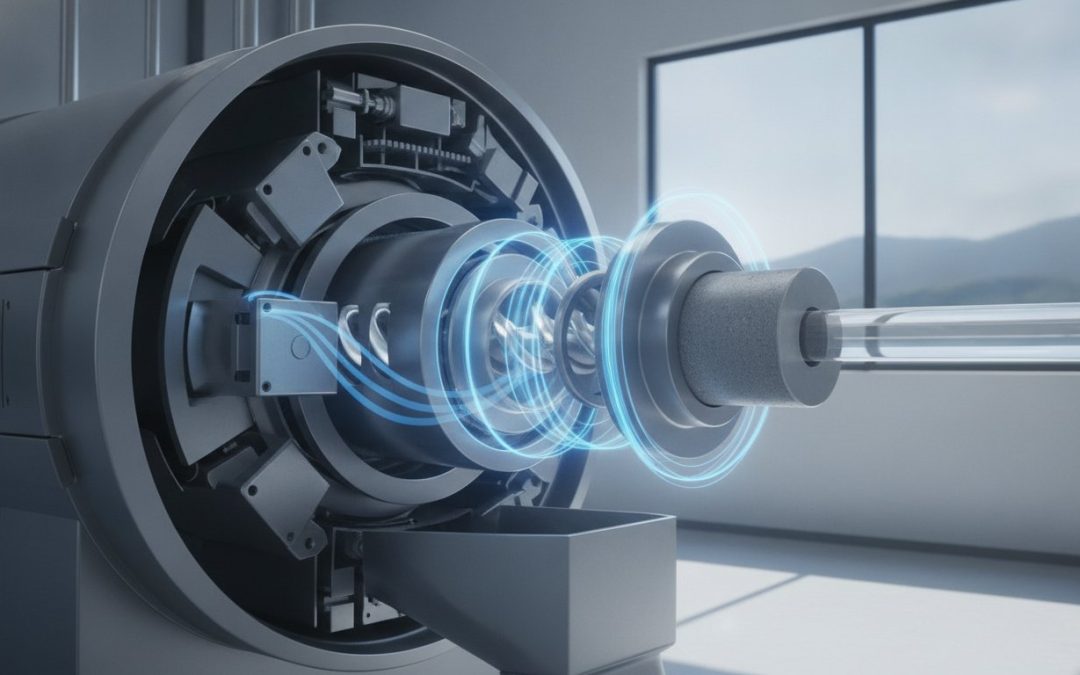
Increasing the RPM of your separation equipment is often a costly miscalculation that prioritises mechanical speed over actual process efficiency. Many Australian plant managers struggle with high moisture content in cake solids and spiralling energy costs, largely because the fundamental physics of centrifuge centrifugal force remains misunderstood or misapplied at the site level. Sacor recognises that achieving peak performance requires a precise application of physics, where every kilowatt of energy is directed toward specific separation outcomes rather than unnecessary mechanical wear.
You’ll gain the technical clarity required to master Relative Centrifugal Force (RCF) calculations, allowing you to optimise your industrial separation and significantly reduce operational expenditure across your facility. This guide examines the critical relationship between bowl geometry and G-force, provides proven strategies for achieving maximum solids dryness, and outlines the selection criteria for equipment engineered to withstand the rigorous conditions of Australian industrial sites. By aligning your separation strategy with these core physical principles, you can transform your processing line into a model of efficiency and environmental responsibility.
Key Takeaways
- Master the calculation of Relative Centrifugal Force (RCF) to ensure your separation equipment delivers consistent results regardless of the machine’s mechanical speed.
- Understand the role of bowl geometry and inertia in how centrifuge centrifugal force effectively separates solids from liquids to improve product recovery rates.
- Learn to identify the precise force required to maximise cake dryness while protecting the integrity of your product and reducing unnecessary mechanical wear.
- Discover how custom-engineered solutions can be tailored to the unique feed characteristics of Australian industrial sites to lower total operational expenditure.
- Gain confidence in selecting and commissioning equipment by following a structured, physics-based approach to industrial separation.
Understanding Centrifugal Force in Industrial Centrifuge Systems
Centrifugal force is the mechanical foundation of every decanter system operating across Australia’s mining and wastewater sectors. While often described as a single outward push, it’s technically an apparent force resulting from the inertia of particles within a rotating frame of reference. For site engineers, Understanding Centrifugal Force is less about theoretical physics and more about the practical application of acceleration to achieve phase separation at speeds impossible under standard earth gravity. By harnessing this phenomenon, plants can process high-volume slurries with a level of precision that static systems cannot replicate.
It’s crucial to distinguish between centripetal and centrifugal forces within the rotating bowl. The centripetal force is the actual inward physical force exerted by the bowl wall to keep the slurry moving in a circular path. Conversely, the centrifuge centrifugal force is the outward force perceived by the solids as they attempt to maintain their straight-line inertial path. This outward pressure forces heavier particles against the bowl wall, creating a compressed layer of solids that can be mechanically discharged by the internal scroll. This mechanism is the primary driver of rapid solid-liquid separation, allowing for continuous processing without the downtime associated with traditional filtration.
The Mechanics of Industrial Sedimentation
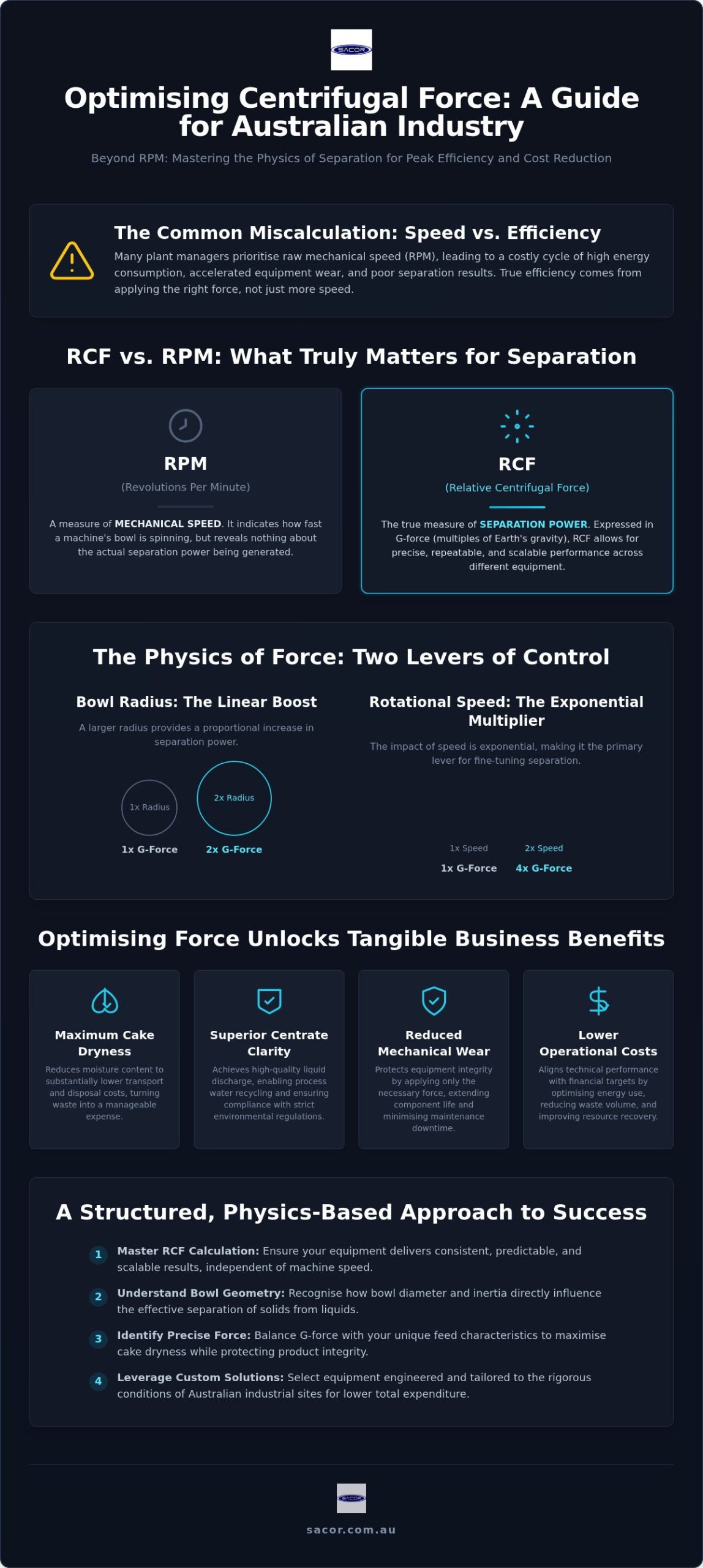
Industrial sedimentation relies on the disparity in density between liquids and solids. While a static settling tank depends on the constant 1G of earth’s gravity, a decanter centrifuge accelerates this process by generating several thousand Gs. This acceleration is governed by the relationship between the bowl’s radius and its rotational velocity. Increasing the radius provides a linear boost to the force, while doubling the rotational speed results in a fourfold increase in the applied force. High-volume Australian process streams, particularly in mineral processing and tailings management, rely on decanters to achieve rapid throughput within a compact footprint that static tanks simply cannot match.
Why Centrifugal Force Matters for Your Bottom Line
The magnitude of applied force directly dictates the moisture content of your final discharge. In many Australian mining operations, transport costs represent a significant portion of the total operational budget. Reducing the moisture content in cake solids by even a small percentage can lead to substantial savings in haulage and disposal fees. High centrifugal force also ensures superior centrate clarity, which is essential for plants aiming to recycle process water or meet stringent environmental discharge regulations. By optimising this force, plant managers achieve a dual benefit of reduced waste volume and improved resource recovery, aligning technical performance with commercial and environmental targets.
The Physics of Separation: How Centrifugal Force Drives Efficiency
Quantifying the intensity of separation requires a shift from measuring simple rotational speed to calculating Relative Centrifugal Force (RCF). While many operators focus on RPM, RCF is the metric that defines the actual force exerted on the particles, expressed as a multiple of the Earth’s gravity. The basic centrifugal force definition establishes that this is an inertial effect, yet in a decanter, we must account for both the bowl’s physical dimensions and its velocity. This calculation allows engineers to standardise performance across different equipment sizes, ensuring that a process developed on a pilot scale can be accurately replicated in a full-scale Australian production environment.
The relationship between the bowl radius and the force applied is linear, meaning a larger bowl at the same speed provides a proportional increase in separation power. However, the impact of rotational speed is exponential. If you double the RPM of a machine, you quadruple the centrifuge centrifugal force acting on the solids. This mathematical reality is why high-speed decanters are the preferred choice for capturing fine particles that would otherwise remain suspended. It’s the primary lever for increasing throughput, though it necessitates a sophisticated understanding of the equipment’s mechanical limits to prevent premature wear.
Stokes’ Law in a Rotating Environment
Applying classical physics to a high-speed decanter requires adapting Stokes’ Law to account for the massive acceleration generated within the bowl. The force must be sufficient to overcome the viscous drag of the carrier liquid, which often resists the movement of smaller particles. Higher G-forces exponentially increase terminal settling velocity, allowing particles to reach the bowl wall significantly faster than they would under standard gravity. This acceleration transforms separation times from hours or days in a static tank into a matter of seconds within a continuous process stream.
Material Stress and Structural Integrity
Containing thousands of Gs creates immense centrifugal tension that challenges the structural integrity of the rotating assembly. At these extreme velocities, the bowl must maintain its shape and balance despite the heavy internal load of the slurry. Sacor utilises high-grade stainless steel for bowl construction to manage these stresses while providing the corrosion resistance required for harsh Australian site conditions. If you’re evaluating your current equipment’s performance, exploring our Decanter Centrifuge Systems can provide insights into how modern metallurgy and precision engineering handle these physical demands. Balancing high G-force with mechanical robustness ensures the system delivers peak dryness without compromising the safety or longevity of the plant’s assets.
RCF vs RPM: Why the Distinction Is Critical for Plant Managers
Plant managers often fall into the trap of using Revolutions Per Minute (RPM) as a primary benchmark for equipment performance. While RPM indicates how fast the motor is turning the bowl, it fails to account for the physical dimensions of the machine, making it a poor metric for cross-model comparisons. To evaluate the actual separation capability, you must focus on Relative Centrifugal Force (RCF), which represents the true centrifuge centrifugal force applied to the product. Relying on RPM alone can lead to significant procurement errors; a smaller machine spinning at a high rate may still generate less separation power than a larger, slower-spinning unit.
Converting manufacturer specifications into comparable RCF values is an essential step for any technical evaluation. The calculation integrates the rotational speed with the rotating radius, ensuring that the G-force listed on a data sheet is an objective reflection of performance. Without this standardisation, you risk under-specifying equipment for demanding applications like tailings dewatering or wastewater treatment. It is the difference between buying a machine based on motor speed and investing in one based on its ability to move mass effectively under load.
The Radius Factor: Why Size Matters
Bowl geometry is the silent partner in the separation equation. A small-diameter centrifuge requires significantly higher speeds to match the G-force produced by a larger unit at a lower velocity. This has practical implications for dewatering efficiency and mechanical longevity. Larger bowls typically offer a longer clarification zone and can handle higher volumes, while smaller units might be preferred for specific fine-particle captures where high RPM is sustainable. Choosing the correct radius ensures that the force is distributed effectively across the feed, preventing the bypass of solids that often occurs in poorly sized equipment.
Standardising Performance Metrics Across Sites
For organisations operating multiple facilities across Australia, from the Pilbara to the Hunter Valley, standardising on RCF is the only way to ensure process consistency. If a separation process is optimised for 3,000 Gs in a Western Australian mining operation, that same force must be replicated in other sites to achieve identical cake dryness and centrate clarity. Sacor prioritises G-force specifications during the custom design phase to ensure that our Mining Separation Solutions meet these site-specific requirements. This level of precision is also critical for environmental compliance, where accurate reporting of solids recovery is often a regulatory necessity for Australian industrial licenses.
Optimising Force: Balancing G-Force with Feed Characteristics
A common misconception in industrial separation is the belief that higher force always yields a better outcome. While increasing the centrifuge centrifugal force can improve solids dryness, there is a technical “sweet spot” where performance is maximised without compromising the integrity of the product or the equipment. Excessive G-force often leads to the shearing of delicate particles, which creates fines that are significantly harder to capture, ultimately resulting in a dirtier centrate and a loss of valuable material.
Effective separation requires a balance between the applied force and the retention time of the slurry within the bowl. This is managed through pond depth adjustments, which dictate how long the feed remains under the influence of the centrifugal field. For high-viscosity fluids or streams with extremely fine particle sizes, a deeper pond and higher force may be necessary to overcome liquid resistance. Conversely, for granular solids that settle easily, lower forces are often sufficient, allowing for reduced energy consumption and lower maintenance costs over the machine’s lifecycle.
Managing Flocculation and Chemical Pre-treatment
Chemical pre-treatment using polymers is frequently employed to aggregate fine particles into larger, more manageable flocs. The interaction between these chemical bonds and the centrifuge centrifugal force is a critical operational variable. If the G-force is too high, the shear stresses generated during acceleration can physically tear the polymer-bound flocs apart, reversing the benefits of the pre-treatment. Optimising your chemical expenditure involves finding the lowest effective G-force that maintains floc stability while achieving the required solids dryness, a process that requires site-specific testing and precision engineering.
Troubleshooting Common Separation Issues
When centrate remains cloudy despite high rotational speeds, the issue is rarely solved by simply increasing the speed further. It often indicates that the retention time is insufficient or that internal turbulence is preventing the solids from settling against the bowl wall. Adjusting the scroll differential speed can help manage the solids discharge rate, ensuring that the cake is compressed effectively before leaving the machine. You can identify the point of diminishing returns for G-force when incremental increases in rotational speed fail to produce a measurable reduction in cake moisture while simultaneously increasing vibration and energy draw. If you are experiencing persistent separation challenges, our team provides Maintenance and Technical Support Services to help recalibrate your system for optimal performance.
Custom Separation Solutions: Leveraging Centrifugal Force with Sacor
Sacor translates the complex physics of centrifuge centrifugal force into dependable, site-specific engineering that addresses the unique challenges of the Australian industrial landscape. We don’t merely supply hardware; we provide integrated separation solutions that are tailored to the specific G-force requirements of your process stream. Our methodology involves a thorough analysis of feed characteristics and throughput goals, ensuring that every decanter system is commissioned with the precise configuration required to achieve peak performance. This technical rigour is backed by comprehensive documentation, providing site engineers with the clarity needed to maintain operational standards and meet environmental compliance targets.
Our commitment to sustainable industrial practice is reflected in the efficiency of our systems. By precisely matching the centrifugal field to the material requirements, we help plants reduce their energy consumption and minimise the volume of waste generated. This results-focused approach ensures that our technology serves as a long-term asset for your facility, contributing to both your environmental responsibilities and your commercial profitability.
Engineering for the Australian Environment
Operating in remote regions like the Pilbara or the Bowen Basin requires equipment that can withstand extreme temperatures and variable feed qualities. Sacor’s Mining Separation Solutions are engineered for these harsh conditions, focusing on structural robustness and continuous, high-G operation. We collaborate directly with site engineers to optimise existing plant infrastructure, ensuring that new separation stages integrate seamlessly with your current workflows. This partnership approach reduces the risk of integration bottlenecks and ensures that the equipment delivers the promised efficiency from day one without requiring excessive oversight.
Maximising Uptime with Expert Maintenance
The high-speed nature of decanter systems means that even minor imbalances can lead to significant mechanical stress and reduced separation efficiency. Maintaining the correct centrifuge centrifugal force requires a commitment to precision maintenance, where regular balancing and the use of genuine spare parts are non-negotiable. Sacor provides national Maintenance and Technical Support Services, ensuring that your facility has access to the expertise required to maintain consistent force output and prolong asset life. Maintaining this mechanical precision is not only a matter of reliability; it’s a proactive strategy to prevent unplanned downtime and reduce total lifecycle costs. Contact Sacor to organise a site-specific separation audit and discover how our expertise can refine your process.
Advancing Separation Efficiency through Precision Engineering
Mastering the physics of industrial separation is a prerequisite for any plant manager aiming to reduce moisture content and operational overheads. We’ve established that Relative Centrifugal Force remains the only objective benchmark for comparing equipment performance and ensuring process consistency across multiple sites. By moving beyond simple rotational speed and focusing on the relationship between bowl geometry and material characteristics, you can identify the precise operational sweet spot that prevents particle shearing while maximising solids recovery. Applying the correct centrifuge centrifugal force is not merely a technical choice but a strategic investment in the long-term sustainability and profitability of your Australian facility.
Sacor provides the domain expertise required to translate these physical principles into high-performance assets. As an Australian-owned and operated specialist, we offer bespoke engineering solutions tailored to the rigorous demands of the mining, wastewater, and food sectors. Our commitment to your success extends through our comprehensive spare parts supply and a national maintenance network designed to ensure your equipment maintains peak structural integrity. Optimise your separation process with a customised Sacor centrifuge solution today. We look forward to partnering with you to achieve a more efficient and environmentally responsible processing future.
Frequently Asked Questions
What is the difference between centripetal and centrifugal force in a centrifuge?
The centripetal force is the physical inward force exerted by the rotating bowl wall to keep the slurry in a circular path. The centrifuge centrifugal force is the apparent outward force experienced by the particles due to their inertia, which drives them toward the bowl wall to facilitate solid-liquid separation. This outward pressure is what allows the machine to overcome the natural buoyancy of particles in a liquid carrier.
How is centrifugal force calculated for an industrial decanter?
Relative Centrifugal Force (RCF) is calculated using the standard formula RCF = 1.118 × 10⁻⁵ × r × (RPM)², where ‘r’ is the rotating radius measured in centimetres. This calculation is essential for site engineers to determine the exact G-force applied to the feed material. Accurate RCF values allow for the standardisation of performance across different equipment models regardless of their mechanical dimensions.
Why is RCF more important than RPM in separation processes?
RCF provides an objective measure of separation power that remains consistent across machines of different sizes, whereas RPM only measures rotational speed. Two different centrifuges spinning at the same RPM will produce vastly different forces if their bowl diameters vary. For plant managers, focusing on RCF ensures that the required separation intensity is achieved regardless of the specific equipment’s motor speed.
Can centrifugal force damage the particles being separated?
Excessive force can indeed damage delicate particles or shear polymer-bound flocs, which often results in a cloudy centrate and reduced recovery rates. Finding the technical “sweet spot” involves balancing the force required for cake dryness against the physical limits of the material. If the force is too high, the resulting particle degradation can make downstream processing significantly more difficult and expensive.
What G-force is typically required for mining tailings dewatering?
Mining tailings typically require between 2,500 and 3,500 Gs to achieve the cake dryness necessary for efficient transport and disposal in Australian operations. The specific requirement depends on the particle size distribution and the mineralogy of the slurry. Finer tailings often necessitate higher forces to overcome the viscous drag of the liquid and achieve clear centrate for water recycling.
How does bowl diameter affect the centrifugal force produced?
The centrifugal force produced increases linearly with the radius of the bowl when the rotational speed is held constant. This relationship means a larger bowl diameter provides more separation power at a lower RPM, which helps reduce mechanical wear and energy consumption. It’s often more efficient to use a larger bowl at a moderate speed than a small bowl at extreme velocities.
What role does centrifugal force play in three-phase separation?
In three-phase separation, the force exploits the specific gravity differences between solids, oil, and water to create three distinct stratified layers within the bowl. The heaviest solids are forced to the outer wall, while the water and oil form concentric inner layers based on their densities. This allows for the simultaneous discharge of all three phases, which is critical for oil recovery and food processing applications.
How often should a centrifuge be serviced to maintain its force efficiency?
Service intervals depend on the abrasiveness of the feed and the total operating hours, but regular balancing and vibration monitoring are critical for high-G machines. Maintaining the structural integrity of the rotating assembly ensures the centrifuge centrifugal force remains consistent and prevents mechanical failures. Proactive maintenance on the scroll and bowl prevents the gradual loss of separation efficiency caused by surface wear.