The right separation equipment isn’t necessarily the most advanced option; it’s the one matched to your wastewater stream and process duty. Choosing industrial wastewater separation equipment can be challenging when flow rates and feed composition vary. A poor fit may affect downstream treatment and make solids handling harder to plan.
Selection depends on more than the equipment label. The required outputs, operating conditions and site constraints all affect suitability, as does the equipment’s role within the wider treatment process.
This guide explains how common separation options work and what process data to gather before comparing them. You’ll learn how to define the duty and required outputs, assess technologies against feed characteristics and throughput targets, and consider integration, commissioning and lifecycle support. It also outlines what to prepare before speaking with a supplier, so discussions focus on your plant’s requirements rather than a machine in isolation.
Key Takeaways
- Start with the separation duty and required outputs, rather than selecting a machine first.
- Compare industrial wastewater separation equipment by feed characteristics, process role and operating demands, not by a universal ranking.
- Use feed analysis and flow profiles to clarify the conditions a suitable system must handle.
- Check how the separation stage will integrate with downstream treatment and solids handling.
- Understand how decanter, three-phase centrifuge and disc separator systems may fit different process requirements, then assess commissioning and lifecycle support.
Industrial wastewater separation equipment starts with the treatment duty
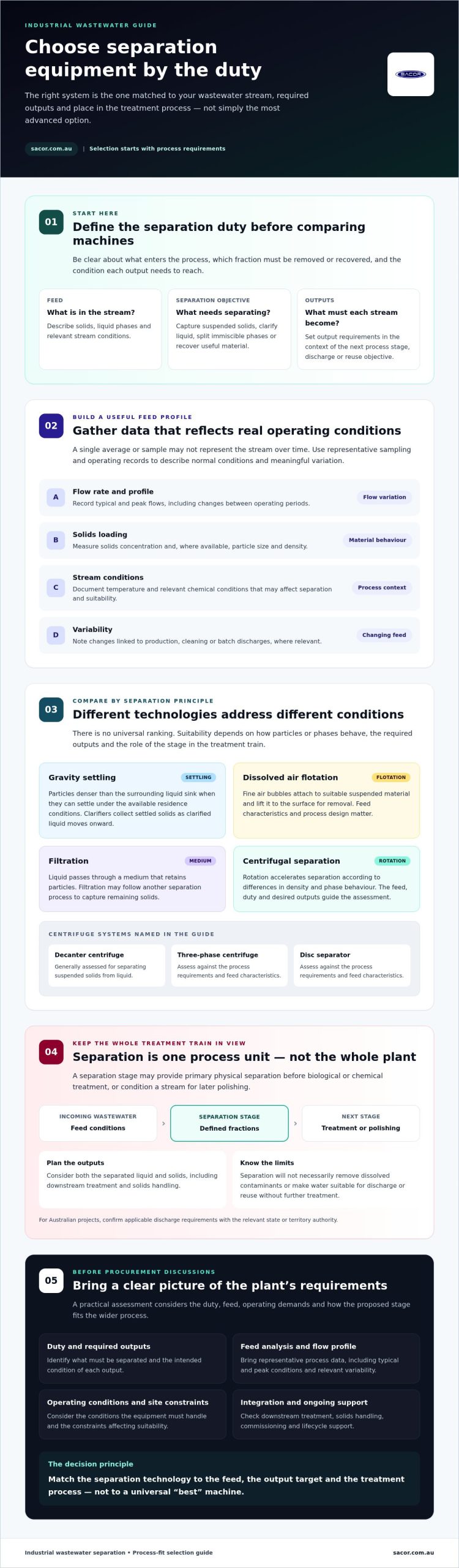
Industrial wastewater separation equipment removes suspended solids, separates liquid from solids or divides distinct liquid phases, such as oil and water. Start by defining the treatment duty: what the incoming stream contains, which fraction needs to be removed or recovered, and what condition each output must reach.
Separation equipment is a process unit that divides wastewater into defined fractions; it is not, by itself, a complete wastewater treatment plant. It may provide primary physical separation before biological or chemical treatment, or condition a stream for a later polishing stage. It won’t necessarily remove dissolved contaminants or deliver water suitable for discharge or reuse without further treatment.
What separation is intended to achieve
Define the feed stream and separation objective before comparing equipment. A process may need to capture suspended solids, clarify a liquid, split immiscible phases or recover useful material from a waste stream. These are different duties, and the intended outcome determines what the equipment must separate and how its outputs will be managed.
For example, a solids-laden wash stream may need solids capture before downstream treatment, while a stream containing separate liquid phases may need phase separation. In either case, the separated liquid may still require biological, chemical or polishing treatment. Industrial wastewater treatment processes can include several stages, with separation forming one part of a broader treatment train rather than addressing every contaminant on its own.
Set the required quality for each output in context. Discharge and reuse objectives depend on the site, the next process stage and applicable requirements. For Australian projects, confirm relevant discharge requirements with the appropriate state or territory authority.
Why wastewater characteristics matter
Equipment assessment depends on the feed, not just the plant’s average flow. Gather process data that describes typical operation and meaningful variation, so a proposed system can be assessed against actual conditions.
- Flow rate and profile: record typical and peak flows, including changes between operating periods.
- Solids loading: measure solids concentration and, where available, particle size and density. These characteristics influence how readily material separates.
- Stream conditions: document temperature and relevant chemical conditions, as these can affect separation behaviour and equipment suitability.
- Variability: note changes linked to production, cleaning or batch discharges, where relevant to the site.
Representative sampling and operating records help distinguish normal feed conditions from short-lived peaks. This evidence gives engineers and suppliers a sounder basis for assessing the duty, expected outputs and fit within the treatment train. Assumptions based on a single sample may not reflect the stream the equipment needs to handle over time.
How industrial wastewater separation technologies work
Separation technologies use different physical forces to divide wastewater into useful fractions. The best fit depends on how particles or phases behave in the feed, the required outputs and the role of the stage within the treatment train. Gravity, flotation, filtration and centrifugal force address different separation conditions; none is a universal solution.
Gravity, flotation and filtration in a treatment train
Gravity settling allows particles denser than the surrounding liquid to sink, provided they can settle under the available residence conditions. Clarifiers use this principle to collect settled solids while clarified liquid moves onward. Dissolved air flotation (DAF) works differently: fine air bubbles attach to suitable suspended material and lift it to the surface for removal. Both methods depend on feed characteristics and process design.
Filtration is a distinct stage in which liquid passes through a medium that retains particles. It may follow another separation process to capture remaining solids, but its suitability depends on the required output and the material being treated. These examples describe treatment technologies, not equipment supplied by Sacor. For Australian projects, confirm applicable discharge requirements with the relevant state or territory authority, as treatment needs depend on the site and its intended discharge or reuse.
Where centrifugal separation may fit
Centrifuges use rotation to accelerate separation according to differences in density and phase behaviour. A decanter centrifuge is generally assessed for separating suspended solids from liquid, while a three-phase centrifuge may be considered where a feed contains two liquid phases and solids. Disc separator systems may suit other liquid separation duties. These are broad process roles, not performance guarantees; suitability depends on the feed and required outputs.
A decanter centrifuge separates solids from liquid by applying rotational force to move denser solids away from the liquid phase. The separated fractions then leave the process for their intended handling or further treatment.
Feed testing and engineering assessment should establish whether centrifugal separation matches the stream, throughput target and operating conditions. Sacor supplies decanter, three-phase centrifuge and disc separator systems, with solution design informed by feed characteristics and site conditions. If your plant is assessing a centrifugal option, review Sacor’s industrial wastewater separation solutions as part of the process evaluation.
Compare wastewater separation equipment by feed, output and operating demands
Compare technologies against the stream and the job each stage must perform. A system that captures settleable solids may not address fine suspended material or separate liquid phases. A process that produces a suitable intermediate stream may still need downstream treatment. No single technology handles every wastewater feed, so assess the full treatment train rather than choosing by equipment category alone.
| Technology | Process role and feed considerations | Output and integration considerations |
|---|---|---|
| Centrifugal separation | Uses rotational force to separate phases according to differences in their behaviour. Assess solids characteristics, liquid phases and the required throughput. | Can produce separated fractions for further handling or treatment. Confirm operating targets and how the system connects with existing process stages. |
| Gravity settling | Relies on particles settling under gravity. Consider whether solids can settle under the available process conditions and residence time. | Settled solids and clarified liquid may require separate downstream handling or treatment. |
| Flotation | Uses bubbles to lift suitable suspended material towards the surface for separation. | May form a treatment stage before or alongside other processes; assess how the separated material and liquid will be managed. |
| Filtration | Passes liquid through a medium that retains particles. Feed solids and the required separation objective inform its role. | May be used as a distinct or subsequent treatment stage. Consider its place in the process and the handling of retained solids. |
Centrifuge or gravity-based separation
Both approaches separate solids from liquid, but their mechanisms differ: gravity relies on settling, while centrifugal separation uses rotation. Assess how the solids behave in the actual feed, the flow profile and whether the duty requires continuous processing. Check the proposed system’s operating requirements and how it interfaces with upstream and downstream stages. Sacor’s wastewater treatment centrifuge guide provides further context on centrifuge applications.
Flotation or filtration as complementary approaches
Engineers may assess flotation where suspended material is suited to bubble-assisted separation, or filtration where retaining particles in a medium fits the process objective. These are treatment-train options, not equipment categories supplied by Sacor. Evaluate their suitability, operating demands and contribution to the required output against representative feed data and project-specific evidence.
For any industrial wastewater separation equipment comparison, treat expected performance as specific to the feed, testing and system configuration. Confirm target outputs, operating conditions and integration requirements before deciding between alternatives. A technology ranking without that context can misdirect the selection.
Assess an industrial wastewater separation system before procurement
Before selecting industrial wastewater separation equipment, assemble the process and site information needed to assess fit. A clear specification helps suppliers evaluate the actual duty, identify interfaces with existing treatment stages and clarify what needs to be confirmed before commissioning.
Process information to gather
Build a representative picture of the wastewater stream, including normal operation and expected variability. Record:
- Feed analysis: representative sample results, solids concentration and characteristics, and relevant chemical and temperature conditions.
- Flow profile: operating flow ranges, peaks and changes associated with production or cleaning cycles.
- Required outputs: the intended condition of each separated stream and how it will be used, discharged or treated next.
- Site constraints: available footprint, utilities, control requirements, access for operation and maintenance, and tie-ins to existing equipment.
These inputs support engineering review and help identify gaps in the available data. For Australian sites, discharge requirements depend on the project and jurisdiction. Confirm applicable obligations with the relevant state or territory authority rather than assuming one requirement applies everywhere.
Questions to resolve before installation
Use the project information to work through a procurement sequence before committing to a system:
- 1. Define the duty. Specify what the separation stage must remove or recover, the expected feed conditions and the intended output.
- 2. Confirm the design basis. Review sample data, flow variation and site constraints with the supplier, and identify any further testing or engineering assessment needed.
- 3. Map the interfaces. Agree how the equipment will connect with existing treatment stages, utilities and controls, and clarify operator responsibilities.
- 4. Set acceptance arrangements. Document the agreed operating and output criteria, along with how performance testing will be conducted and assessed. Criteria should reflect project-specific evidence and defined feed conditions.
- 5. Confirm delivery and commissioning scope. Clarify who is responsible for equipment supply, installation, commissioning and technical documentation, and what information or access the plant must provide.
- 6. Plan lifecycle support. Discuss maintenance access, wear-part requirements and spare-parts support. Sacor’s industrial centrifuge spare parts guide can inform lifecycle planning.
Resolve these points early to make supplier discussions more specific and reduce ambiguity around integration and ongoing operation. To discuss process requirements for a centrifugal separation solution, contact Sacor about your wastewater application.
Work with Sacor on a wastewater separation solution
Industrial wastewater separation equipment needs to suit the process duty and the realities of the plant. Sacor supplies centrifugal separation solutions to industrial operators across Australia, working with plant engineers and managers to connect feed characteristics, throughput targets and site conditions with an appropriate equipment scope.
Sacor supplies decanter centrifuge, three-phase centrifuge and disc separator systems. The right system depends on the stream and intended outputs, so selection should be based on project requirements rather than assumed performance. This assessment-led approach gives the project team a clearer basis for discussing process fit, integration and operating needs before procurement.
From process requirements to equipment scope
Early collaboration helps define what the separation stage must achieve and how it will fit within the plant. Feed characteristics, throughput objectives and site conditions inform customised solution design, while existing treatment stages and site interfaces help shape installation planning. The project scope can include equipment supply, installation and commissioning, with technical documentation and commissioning support accompanying equipment supply.
Agreeing responsibilities and requirements with the supplier before installation also helps clarify the information, access and coordination needed from the plant team. Acceptance criteria and performance testing arrangements should be agreed for the specific project, based on its defined feed conditions and objectives.
Plan for operation and ongoing support
Procurement planning should account for the equipment lifecycle, not just delivery and installation. Consider maintenance access, wear-part requirements and how spare parts will be sourced, as these factors influence how the plant prepares to operate and maintain the system. Sacor provides maintenance, spare parts and technical support across the equipment lifecycle.
For related solids-handling applications, Sacor’s sludge dewatering centrifuge guide offers further context on a specific centrifugal separation duty. Use it alongside your own process data when assessing equipment options.
To discuss a wastewater separation solution, speak with Sacor about your feed characteristics, throughput targets and site conditions. Sharing those details helps focus the discussion on your process requirements and the equipment scope your plant needs to evaluate.
Make your next separation decision with confidence
Effective industrial wastewater separation equipment selection starts with the treatment duty, not a preferred machine. Match the technology to feed characteristics, required outputs and operating conditions, then assess how it will integrate with existing treatment stages and site constraints.
Good project planning also depends on useful process data and clear expectations. Representative feed information, flow profiles and target outputs give engineers a stronger basis for assessing suitability. Commissioning requirements, maintenance access and spare-parts planning help shape the equipment scope beyond procurement.
Sacor works with industrial operators across Australia to assess centrifugal separation requirements and develop solutions informed by process needs and site conditions. Support can include custom engineering, equipment supply with technical documentation and commissioning support, as well as maintenance, spare-parts supply and technical support.
Prepare your feed characteristics, throughput targets and site information, then discuss your industrial wastewater separation requirements with Sacor. A considered assessment is a practical first step towards selecting equipment that fits your plant and its wider treatment process.
Frequently Asked Questions
What is industrial wastewater separation equipment?
Industrial wastewater separation equipment separates suspended solids, liquids or distinct phases within an industrial wastewater stream. It may capture solids, clarify liquid, separate oil and water, or recover useful process material. Separation is usually one stage in a treatment train, rather than a complete treatment plant. Dissolved contaminants may need biological, chemical or polishing treatment, depending on the feed, intended reuse or discharge, and applicable requirements.
Which equipment is used to separate solids from industrial wastewater?
Options include clarifiers for gravity settling, dissolved air flotation (DAF) for suitable suspended material, filtration stages that retain particles, and centrifuges that use rotation to separate solids from liquid. The appropriate method depends on factors such as solids concentration, particle properties, flow profile and required output. Sacor supplies centrifugal separation systems, including decanter centrifuges, but does not supply filtration equipment.
How does a centrifuge separate solids from wastewater?
A centrifuge rotates the wastewater so differences in density help separate solids from liquid. In a decanter centrifuge, denser solids move towards the bowl wall, while the liquid forms a separate layer; a conveying mechanism moves the solids towards discharge. The actual separation result depends on the feed and system configuration. Assess representative wastewater and agree project-specific operating targets before selecting equipment.
Can one separation system treat every industrial wastewater stream?
No single separation system is suitable for every industrial wastewater stream. A feed with settleable solids presents a different duty from one containing fine suspended material or distinct liquid phases. Production changes can also affect flow and composition. Assess the stream and required outputs first, then determine whether one separation stage is suitable or whether it needs to work alongside other treatment processes.
What information is needed to select wastewater separation equipment?
Prepare representative feed analysis and records of expected variability and operating flow ranges. Include solids concentration and characteristics, relevant temperature and chemical conditions, and the target condition of each separated stream. Site layout, available utilities, control requirements and connections to existing treatment stages also matter. This information gives engineers a practical basis for assessing suitability and identifying where further testing may be needed.
Does industrial wastewater separation equipment meet discharge requirements?
Not necessarily on its own. Separation equipment may remove solids or divide phases, but the resulting liquid can still contain contaminants that require further treatment. Discharge requirements vary by site and jurisdiction in Australia. Confirm applicable obligations with the relevant state or territory authority, and define the treatment stages and project-specific acceptance criteria needed to assess the final effluent.
What should be considered after wastewater separation equipment is installed?
After installation, follow the agreed commissioning and operating procedures, monitor feed conditions and separated outputs, and plan maintenance around the equipment’s requirements. Confirm that operators understand controls and routine checks, and consider access to wear parts and spare parts before they’re needed. Ongoing maintenance and technical support can help plant teams manage the equipment lifecycle as operating conditions change.