The fastest dewatering option isn’t automatically the right one for your site. A settling pond may suit an operation with sufficient land and retention time, while mechanical dewatering may reduce the process footprint and provide a more equipment-based approach. The settling pond vs mechanical dewatering decision depends on how your slurry behaves and what your operation needs, not on equipment labels alone.
Compare land availability, water recovery, tailings handling and operating demands alongside capital planning and ongoing maintenance. Performance can vary with feed characteristics and site conditions, so generic comparisons won’t establish which approach will work best for your operation.
This article compares the two approaches by process performance, site constraints and whole-of-life considerations, including where each has limitations. It also outlines the data and testing to gather before developing a project-specific solution. A decanter centrifuge is one mechanical option for technical assessment. Sacor can work with plant teams to consider process requirements and site conditions as part of a customised separation solution.
Key Takeaways
- Compare settling ponds and mechanical dewatering against your slurry characteristics and operational objectives, not generic performance claims.
- Assess how each option affects land footprint, water recovery, solids handling and day-to-day operating demands.
- Use the settling pond vs mechanical dewatering comparison to identify which trade-offs warrant closer investigation at your site.
- Prepare representative slurry data, throughput requirements, operating schedules and current solids-management practices to support a meaningful assessment.
- Where mechanical separation suits your process, consider whether a decanter centrifuge is appropriate for further technical review with your plant team.
Settling pond vs mechanical dewatering: what each approach does
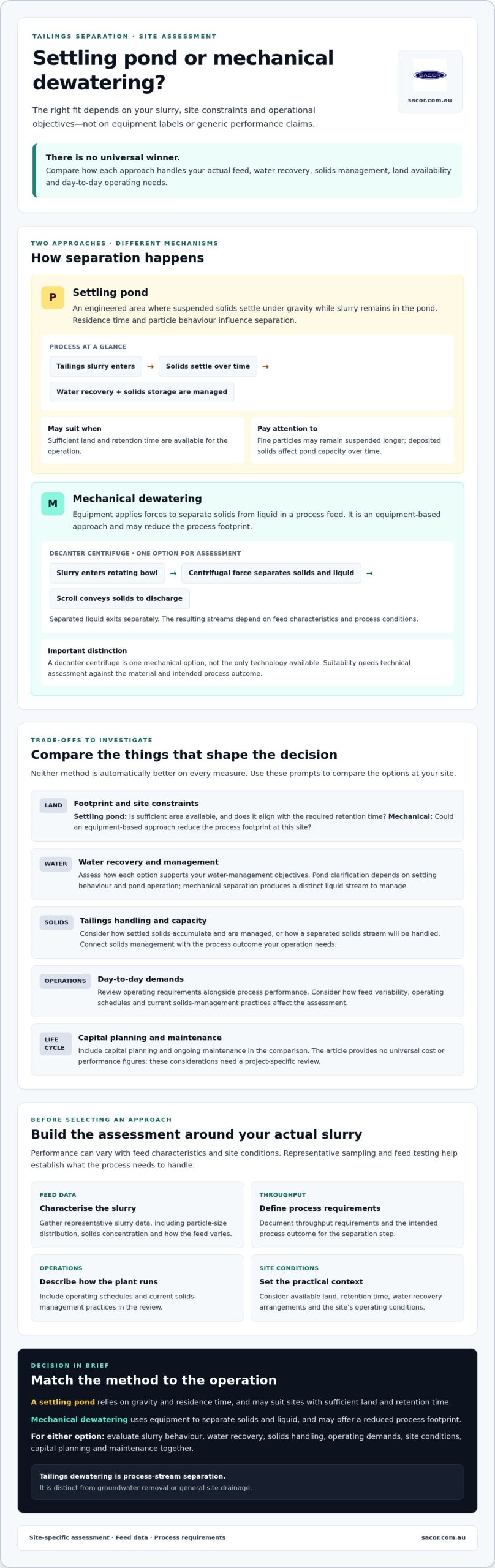
In tailings management, a settling pond and mechanical dewatering both separate solids from liquid, but they rely on different processes. A settling pond is an engineered area where suspended solids in tailings slurry settle under gravity over time. Mechanical dewatering uses equipment to separate a solids stream from the liquid in a process feed.
A Settling basin provides a useful general reference for how basins capture suspended material. In a mining operation, a pond may support clarification, where solids settle so water can be recovered, and storage of settled tailings. These functions are related but not identical. A pond’s storage role doesn’t mean all particles settle at the same rate or that the overflow will meet the operation’s water-management objectives.
How settling ponds separate tailings solids from water
Slurry enters the pond and remains there while gravity draws particles towards the bottom. Residence time and particle behaviour influence separation: coarser or denser particles may settle more readily, while fine particles can remain suspended for longer. Actual performance depends on the slurry’s characteristics and operating conditions, including how the pond is managed and how material enters and moves through it.
The pond therefore acts as a settling and storage area, rather than a controlled equipment process. Its suitability depends on whether the available area, retention time and water-recovery arrangements align with the tailings stream and site objectives.
How mechanical dewatering separates solids and liquid
Mechanical dewatering applies forces through equipment to separate solids from a process stream. A decanter centrifuge is one option, not the only technology available. In a decanter, the feed enters a rotating bowl; centrifugal force separates solids from liquid, and a scroll conveys the solids towards a discharge point while the separated liquid exits separately.
Mechanical dewatering is equipment-based solid-liquid separation, while pond settling relies on gravity and residence time to settle suspended material. The resulting solids and liquid streams can be managed as distinct outputs, with their characteristics dependent on the feed and process conditions.
This distinction also matters for scope. Tailings solids dewatering treats slurry as a process stream. Groundwater removal and general site drainage address water around or within a site, and aren’t interchangeable descriptions of tailings separation.
For the settling pond vs mechanical dewatering decision, assess feed properties, site conditions and water-management objectives together. Neither approach is universally suitable. The relevant question is how each performs with the operation’s actual slurry and practical constraints.
How settling ponds and mechanical dewatering work in practice
The operating sequence differs substantially between a pond and mechanical equipment. In both cases, results depend on the feed: particle-size distribution, solids concentration and variability can influence how readily solids separate and how the resulting streams can be managed. Representative sampling and feed testing help establish those characteristics before a process is selected.
The settling pond process and its operating dependencies
Tailings slurry is delivered to an engineered pond, where available capacity and residence time allow suspended particles to settle. Water can then be recovered from the clarified area, while deposited solids accumulate for ongoing management. Assess these functions together: water recovery depends on pond operation, and solids deposition affects available capacity over time.
Settling behaviour isn’t uniform across tailings streams. Fine particles, changes in solids concentration and variations in feed can affect clarification and deposition, so evaluate pond performance against actual operating conditions. Review how slurry enters the pond, how recovered water is managed, and how accumulated solids are handled as part of the process assessment.
The mechanical dewatering process and its operating dependencies
Mechanical separation follows a more equipment-based sequence: characterise and, where required, condition the feed; deliver it to the selected machine; separate the solids and liquid; then manage each discharge stream. Equipment choice and operating requirements depend on the material and the intended process outcome.
In a decanter centrifuge, slurry enters a rotating bowl, centrifugal force separates solids from liquid, and a scroll rotating at a differential speed conveys the solids to discharge while the separated liquid exits through a separate outlet. Feed consistency can affect operation, while abrasive solids may create wear exposure that warrants assessment. Site teams should also consider operator capability, maintenance planning and how each discharge stream fits downstream handling.
Testing representative feed samples can help compare process options and reveal variability that a single sample may miss. Include samples from relevant operating conditions, alongside throughput requirements and the operating schedule, so the assessment reflects the stream the equipment or pond must manage. Performance and equipment selection require feed-specific engineering assessment. General descriptions alone can’t establish site outcomes.
For a technical review of feed characteristics, throughput targets and site conditions, plant teams can explore industrial decanter centrifuge solutions as one mechanical option to assess, rather than assuming it will replace a pond in every application.
Settling pond vs mechanical dewatering: compare the trade-offs
The practical comparison is about how each option fits the whole operation, not whether one is inherently more efficient. A pond may make use of existing infrastructure, while mechanical equipment may be worth assessing where space or solids discharge presents a documented constraint. Use the following framework to identify what needs verification at your site.
| Assessment factor | Settling pond | Mechanical dewatering |
|---|---|---|
| Footprint | Requires suitable area and pond capacity, including room for accumulated solids and operating needs. | May require less process area, but assess equipment layout, access and integration with the plant. |
| Separation process | Relies on gravity settling and sufficient retention under site operating conditions. | Uses equipment to separate solids and liquid; results depend on feed properties and process settings. |
| Water handling | Consider recovery arrangements, water management and how pond operation affects the water balance. | Assess the separated liquid’s characteristics and whether it can support the operation’s water objectives. |
| Solids handling | Plan for deposition, storage and management of accumulated solids. | Plan for solids discharge and downstream handling, including how the material fits existing practices. |
| Operating demands | Review pond management, monitoring, labour and ongoing solids-management requirements. | Review operator capability, maintenance, energy use, feed variability and equipment support needs. |
| Capital and whole-of-life planning | Assess the existing design and infrastructure alongside future management and maintenance needs. | Assess equipment investment and integration alongside ongoing labour, maintenance, energy and downstream handling. |
Where settling ponds may remain a practical fit
Existing pond infrastructure and site layout can influence whether continued use is practical. Assess retention capacity, water recovery and solids management as connected requirements. The pond’s available capacity and operating design need to accommodate the tailings stream and the operation’s management approach. Site-specific conditions matter, so don’t assume performance or suitability from the presence of a pond alone.
Where mechanical dewatering may warrant evaluation
Mechanical separation merits assessment where a smaller equipment footprint or a defined solids discharge could address an operational constraint. Weigh these potential advantages against feed variability, plant integration, energy use, maintenance planning and ongoing support. Test the separated liquid against water-management objectives rather than assuming it is suitable for reuse.
Use the comparison to identify which assumptions require data, then assess both options against actual process needs and whole-of-life demands. Mechanical dewatering isn’t automatically superior; representative feed testing and site review should guide the decision. Plant teams can discuss process fit with Sacor’s separation team as part of evaluating a decanter centrifuge option.
How to assess the right dewatering approach for your site
A useful assessment connects slurry behaviour with site constraints and water-management objectives. For the settling pond vs mechanical dewatering decision, gather evidence before comparing options or moving towards procurement. Assumptions about feed performance can otherwise distort process design and whole-of-life planning.
What process and site information to gather first
Build a representative picture of the operation, including changes between normal and variable conditions. Record:
- Feed variability, solids concentration, particle characteristics and required throughput.
- Operating schedules and current pond, water-recovery and solids-management practices.
- Available footprint, utilities, existing infrastructure and practical equipment access.
- Water-quality objectives and the current or intended pathways for solids disposal or reuse.
Confirm applicable project and environmental requirements with qualified advisers for the relevant jurisdiction. These requirements can affect design and operating choices, so avoid relying on assumptions drawn from another site or project.
How to validate a pond, mechanical or staged approach
Use a structured sequence to turn the information into a decision:
- Define objectives. Agree on the required throughput, water-management outcomes and solids-handling needs.
- Characterise the feed. Compile representative slurry data and identify variability that could affect separation.
- Map site constraints. Document footprint, infrastructure, utilities, operating capability and downstream handling pathways.
- Compare options. Assess a pond, mechanical dewatering or a potential staged arrangement against the same process targets and site constraints.
- Validate assumptions. Identify whether further sampling, bench testing or engineering review is needed before selecting equipment or modifying infrastructure.
Compare footprint, water balance, residual-solids handling and operating capability using site-specific evidence. Testing can help determine whether available samples represent the feed the process must manage. If a staged or combined approach appears relevant, include it for engineering review rather than treating it as a default solution.
Whole-of-life costs are project-specific. Build the assessment around the operation’s own capital planning, labour, maintenance, energy and downstream handling requirements, without relying on generic price ranges or assumed savings. The result should show which option best aligns with measured feed behaviour and operational priorities, and where uncertainty still needs to be resolved.
To discuss feed characteristics, throughput targets and site conditions for an industrial decanter centrifuge option, discuss your process requirements with Sacor.
Planning mechanical dewatering with Sacor
A decanter centrifuge is one mechanical dewatering option to assess when process requirements and site conditions support equipment-based separation. It isn’t a universal replacement for a settling pond. The settling pond vs mechanical dewatering decision should follow a review of the specific application, backed by reliable feed information and clear operating objectives.
Sacor supplies customised industrial decanter centrifuge and separation systems, working with plant teams to consider feed characteristics, throughput targets and site conditions. An initial process-fit discussion helps establish what the operation needs and what information is available. It doesn’t assume a particular machine or configuration will suit before engineering review.
What to expect from a process-fit discussion
Plant engineers can outline the feed, operating objectives, throughput requirements and existing plant interfaces. Useful information includes available slurry data, expected variability, current solids-management practices and relevant site constraints. These details help frame the technical assessment and show where further testing or verified process information may be needed.
Equipment supply includes technical documentation and commissioning support. Any proposed system configuration depends on engineering review and the quality of the information provided. That review should establish whether the application and interfaces are suitable for further consideration, rather than rely on general performance assumptions.
Support considerations beyond equipment supply
Project planning can also account for the support required across the equipment lifecycle. Sacor provides installation, commissioning, maintenance, spare parts and technical support services. Plant teams can consider these alongside operating schedules, maintenance capability and parts planning when assessing how equipment would fit site requirements.
Set expectations around the operation’s needs and confirm the scope of support relevant to the project. Availability, response times, uptime and process results depend on specific arrangements and conditions, so verify them rather than assume. A clear scope helps connect equipment selection with practical operating and maintenance planning.
For a considered review of feed characteristics, throughput targets and site conditions, discuss your process requirements with Sacor and explore Sacor’s industrial separation solutions.
Use site evidence to guide your next step
The settling pond vs mechanical dewatering decision comes down to how each option fits your slurry, site constraints and water-management objectives. Neither approach is automatically the better choice. Representative feed information and a balanced view of solids handling and operating requirements help establish which deserves further assessment.
Before committing, confirm throughput needs, feed variability, available footprint, water balance and downstream solids pathways. Then weigh capital planning alongside labour, energy, maintenance and support requirements to build a project-specific whole-of-life view.
Sacor works with plant teams to assess industrial decanter centrifuge applications against feed characteristics, throughput targets and site conditions. Equipment supply includes technical documentation and commissioning support, with installation, maintenance, spare parts and technical support also available.
Discuss your industrial separation requirements with Sacor to explore whether mechanical separation merits assessment for your operation. Gather the relevant process information and request a technical discussion about whether a decanter centrifuge could suit your requirements.
Frequently Asked Questions
Is a settling pond the same as a tailings storage facility?
No. A settling pond describes a separation function: suspended solids settle from slurry while water may be recovered. A tailings storage facility can encompass broader storage, containment and tailings-management functions, with its design determined by the project. Terminology and facility design vary, so the terms shouldn’t be treated as interchangeable. Confirm the site’s engineering documentation and relevant approval context with qualified project advisers before making assumptions about what a particular facility includes.
What is the difference between a settling pond and mechanical dewatering?
In a settling pond vs mechanical dewatering comparison, the key difference is how separation occurs. A pond relies on gravity and residence time for suspended solids to settle, while mechanical equipment applies forces to separate solids and liquid from a process stream. A pond requires suitable capacity and solids management; equipment requires process integration and operational support. Feed properties, site constraints and water-management objectives determine which approach merits assessment for a particular operation.
Can mechanical dewatering replace a settling pond?
It may be possible within some project designs, but mechanical dewatering isn’t an automatic replacement for a pond. Assess whether equipment can manage the required feed and throughput, how the separated solids will be handled, and whether the liquid stream fits water-management objectives. Existing infrastructure and project approvals also matter. Before changing an established tailings-management arrangement, use representative testing and engineering review to validate process assumptions and confirm the project context.
How does a decanter centrifuge dewater tailings?
A decanter centrifuge feeds slurry into a rotating bowl, where centrifugal force separates solids from liquid. A scroll conveys the separated solids towards discharge, while the liquid leaves through a separate outlet. The resulting streams depend on feed characteristics and operating design, including particle behaviour and solids concentration. There’s no universal cake-solids or water-recovery result; assess representative material and verify process performance for the specific application before selecting equipment.
Does mechanical dewatering recover water from tailings?
Mechanical dewatering produces a separated liquid stream, but that doesn’t automatically make the liquid suitable for reuse. Its quality and compatibility depend on the feed, separation process, intended use and site controls. Test the liquid stream and assess it against the operation’s water-management objectives and proposed reuse pathway. This helps determine whether further treatment or management steps need consideration before the recovered liquid can be incorporated into site processes.
Which factors determine whether mechanical dewatering is suitable for a mine?
Suitability depends on feed characteristics and variability, required throughput, available footprint, utilities, water balance and how the separated solids will be handled. The assessment should also account for operator and maintenance capability, plant integration and lifecycle requirements. Representative slurry sampling helps describe the material the system must process, while engineering assessment checks its fit with site conditions and operating objectives. Validate these factors before selecting equipment or proceeding to procurement.
Is mechanical dewatering always more cost-effective than a settling pond?
No. There’s no universal cost winner because each option has different project-specific requirements. Compare capital planning and lifecycle demands, including operating costs, maintenance, labour, energy, land, water management and downstream solids handling. Existing infrastructure and site conditions can also affect the assessment. Avoid relying on generic cost ranges or assumed savings; develop a site-based comparison using verified process information and the operation’s relevant planning period.