
A decanter chosen on nameplate capacity alone can still be the wrong fit. Knowing how to choose a decanter centrifuge starts with understanding the feed, because changes in solids concentration, particle size or flow can affect separation and practical throughput.
Capacity is useful when comparing equipment, but a figure in a proposal means little without the assumptions behind it. First define the separation targets and operating conditions. Then assess each option against the same process requirements.
This guide explains how to develop a process-specific specification that suppliers can assess consistently. It covers the feed data to gather, the trade-offs between cake dryness, centrate clarity and throughput, and the operating demands that influence long-term performance. It also explains what to align when comparing proposals and what to prepare for testing, design and commissioning. Treat supplier collaboration and ongoing support as part of the selection process, so the equipment decision connects to practical plant operation.
Key Takeaways
- To work out how to choose a decanter centrifuge, define the required outputs and operating conditions before assessing equipment capacity.
- Consider bowl speed and bowl-to-scroll differential speed together when assessing separation and solids conveyance.
- Compare proposals using consistent measures, including throughput, solids capture, liquid clarity and cake dryness. Check that assumptions are stated.
- Base testing on representative feed samples and documented conditions so results account for the variability your equipment may encounter.
- Assess commissioning, operator handover, maintenance access, spare-parts arrangements and technical support as part of supplier selection.
Start with the process: define what your decanter centrifuge must achieve
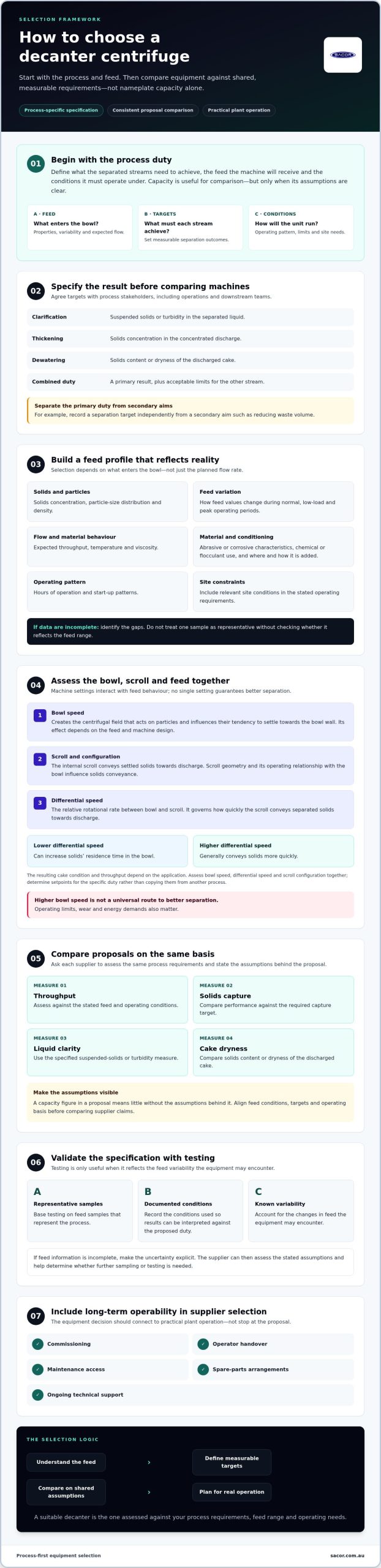
A decanter centrifuge separates suspended solids from liquid using centrifugal force. To understand how to choose a decanter centrifuge, start with the process duty: feed behaviour, required outputs, throughput and operating conditions. Nominal capacity alone doesn’t show whether a unit can meet separation targets across your actual feed range. For a technology overview, see Decanter centrifuge.
Define the separation objective before comparing equipment
Specify the main duty first. Clarification targets a defined level of suspended solids in the liquid. Thickening produces a more concentrated solids stream, while dewatering aims for a specified cake solids content or dryness. Some processes require a combination, such as capturing solids while achieving a target liquid clarity. Record targets in measurable terms, such as suspended solids concentration, solids capture percentage or cake solids content. Separate the primary duty from secondary aims, such as reducing waste volume.
Agree on target measures with process stakeholders, including operations and downstream teams, then validate them against representative feed. This keeps proposals focused on the same outcome rather than incomparable claims. Use the table below as a starting point for defining the result suppliers should assess.
| Process objective | Key result to specify |
|---|---|
| Clarification | Suspended solids or turbidity in the separated liquid |
| Thickening | Solids concentration in the concentrated discharge |
| Dewatering | Solids content or dryness of the discharged cake |
| Combined duty | Primary result plus acceptable limits for the other stream |
Build a reliable feed profile
Equipment selection depends on what enters the bowl, not just the planned flow rate. Gather available data on solids concentration, particle-size distribution and density. Document how these values change during normal, low-load and peak operating periods. Also note feed temperature and viscosity, abrasive or corrosive characteristics, and any chemical or flocculant use, including where and how it is added.
Include expected throughput and operating conditions such as hours of operation, start-up patterns and site constraints. If feed data are incomplete, identify the gaps instead of treating one sample as representative. A supplier can then assess the proposed duty against stated assumptions and help determine whether further sampling or testing is needed. For broader technology context, read the industrial decanter centrifuge guide.
How feed properties and decanter mechanics affect separation performance
Once the process targets are clear, consider how the feed and machine settings interact. Bowl speed influences the centrifugal force acting on particles and their tendency to settle towards the bowl wall. Its effect depends on the feed and machine design. A higher speed is not a universal route to better separation, and operating limits, wear and energy demands also matter.
Bowl speed, differential speed and scroll configuration
The bowl rotates to create the centrifugal field that separates solids from liquid. The internal scroll moves settled solids towards the discharge, and its geometry and operating relationship with the bowl influence how solids are conveyed through the machine.
Differential speed is the relative rotational rate between the bowl and scroll, and it governs how quickly the scroll conveys separated solids towards discharge.
A higher differential speed generally conveys solids more quickly. A lower rate can increase their residence time in the bowl. The resulting cake condition and throughput depend on the application. Assess bowl speed, differential speed and scroll configuration together against the required outputs and feed behaviour. Setpoints should be determined for the specific duty, not copied from another process.
Feed variation, wear and conditioning
Changes in solids concentration, particle size or flow can affect settling and solids conveyance, which may alter output consistency and operating stability. A feed with finer particles or higher viscosity may behave differently from a coarser, less viscous stream. Consider performance across the expected operating range, not only at a single design point.
Discuss abrasive and corrosive characteristics with the supplier when reviewing wear protection, materials and maintenance needs. These factors can influence component life and the inspection or replacement plan. If the process uses flocculant, document the product and dosing conditions, then confirm compatibility and performance through testing rather than assuming conditioning will produce a particular result.
For wastewater applications, the EPA biosolids fact sheet provides a reference on centrifuge thickening and dewatering objectives. It is a US technical resource, not Australian regulatory guidance. For an Australian process specification, use it alongside site data and application-specific assessment.
These interactions are central to how to choose a decanter centrifuge: specify the feed range, define the outputs, and ask suppliers to explain how the proposed operating settings address both. Discussing feed characteristics and operating conditions with a separation specialist can help translate process data into an application-specific assessment.
Compare decanter centrifuge options against measurable selection criteria
Supplier proposals are comparable only when they use the same process basis. When considering how to choose a decanter centrifuge, set acceptance criteria before reviewing performance figures. Ask each supplier to state the feed assumptions, operating settings, test method and measurement basis behind its results. A throughput figure without solids loading, for example, may not describe the capacity available for your feed.
Set acceptance criteria that proposals can be measured against
Define the feed conditions and throughput basis for assessment, including how representative samples were collected and whether testing covered expected process variation. Agree on measurement methods for each target so proposals can be compared consistently. Ask suppliers to distinguish indicative results from values validated under stated conditions. Clarify any performance commitments and their contractual wording directly with them.
| Criterion | What to compare |
|---|---|
| Throughput | Feed flow and solids loading at the stated operating conditions |
| Solids capture | Proportion of feed solids separated, with the measurement method specified |
| Liquid clarity | Suspended solids or another agreed measure in the separated liquid |
| Cake dryness | Solids content or moisture measure, reported on a consistent basis |
| Operating flexibility | Ability to accommodate the stated range of feed and process conditions |
Record the sample source, test conditions, process settings and analytical methods alongside each result. If a proposal uses a different feed sample or reports a result on a different basis, ask for the difference to be explained before ranking the options. This gives engineering, operations and procurement teams a shared basis for evaluating trade-offs.
Assess operating fit as well as separation results
Separation performance is only part of the selection. Check each proposed system against the plant layout and operating requirements, including equipment footprint, utilities, control-system interfaces and connections to upstream and downstream processes. Review expected wear points in light of the feed, and confirm whether routine inspection and component access suit the site’s maintenance practices.
Include operator requirements, planned availability expectations and the proposed scope of technical support in the comparison. Clarify what documentation, installation planning, commissioning assistance and operator handover are included. Confirm spare-parts arrangements with the supplier. These factors can influence practical operability over the life of the equipment, even when separation results appear similar.
For mining applications, the mining decanter centrifuge guide provides sector-specific context. Keep the proposal assessment focused on your process data and site requirements rather than assuming another application’s configuration will transfer directly.
Validate your decanter centrifuge specification with testing and site data
Process records and supplier proposals establish a starting point, but testing and site checks can expose gaps before the specification is finalised. A structured validation workflow makes assumptions visible and gives engineering, operations and the supplier a common basis for confirming the proposed scope.
- Gather process data: Compile available feed analyses, flow ranges, operating schedules and records of process variability.
- Agree testing objectives: Decide which outputs to measure, such as solids capture, liquid clarity and cake characteristics, and agree how results will be recorded.
- Arrange representative sampling: Document sample origin, collection timing, handling and any conditions that could affect the sample before testing.
- Review results and limitations: Compare findings with the agreed objectives, noting test conditions, assumptions and any feed conditions not assessed.
- Confirm the specification and scope: Resolve outstanding questions with the supplier, including equipment, site interfaces, documentation and commissioning requirements.
Use representative testing to reduce specification uncertainty
A sample that reflects only one operating state may not represent a feed that varies across shifts, production stages or process conditions. Record where and when samples were collected, how they were stored and handled, and whether they represent normal or unusual operation. If the feed varies, discuss with the supplier how to include that variation in the test plan.
Bench or pilot results can inform equipment assessment, but they don’t automatically establish performance at full plant scale. Keep the test report with the specification and state its limitations clearly, including the sample tested, operating settings and measurement methods. This helps prevent indicative results from being mistaken for validated plant outcomes.
Prepare the site and operating requirements
Testing alone can’t confirm that a proposed system will fit the plant. Assemble site information such as the available footprint, access and installation constraints, utilities, control-system interfaces and operating schedule. Map the connections to upstream and downstream equipment, including how separated solids will be handled. Note any constraints that may affect operation or maintenance access.
For wastewater-specific application context, refer to the wastewater treatment centrifuge guide. Use it alongside project-specific process and site data, not as a substitute for validating your own duty.
Knowing how to choose a decanter centrifuge includes checking that the process evidence and site requirements support the same specification. Discuss your application data and testing needs with a separation specialist as you confirm the proposed scope.
Choose a supplier for commissioning, maintenance and long-term operability
A decanter’s separation results matter, but so does the support needed to install, operate and maintain the system over time. When deciding how to choose a decanter centrifuge, assess the supplier’s proposed scope alongside the equipment. Clear responsibilities before procurement help prevent gaps between supply, site preparation and commissioning.
Check the support scope before selecting equipment
Ask what technical documentation is included and whether it covers the equipment configuration, operating requirements and maintenance recommendations. Confirm who is responsible for installation planning, commissioning activities and operator handover, and what your site team must provide. These details help operations and maintenance prepare for the equipment before it arrives.
Discuss maintenance intervals in the context of the proposed duty and feed characteristics. Clarify which components are considered wear parts, how they can be accessed for inspection or replacement, and how the supplier identifies the correct spares. Confirm spare-parts arrangements and the scope of technical support in writing, including how requests are handled and any applicable response arrangements. Support requirements depend on the process, site and agreed scope, so don’t assume a particular level of availability or uptime.
Turn the selection framework into a supplier brief
A concise brief gives suppliers a consistent basis for assessing the application. Include:
- Feed characteristics, expected variability and available process data
- Required separation outcomes and throughput range
- Operating conditions, site constraints, utilities and plant interfaces
- Sampling and testing evidence, including methods, assumptions and limitations
- Documentation, installation, commissioning, maintenance and support requirements
List any unknowns and ask suppliers to identify assumptions in their proposals. This makes it easier to distinguish confirmed information from items that need further testing, site review or agreement. It also gives your team a practical basis for confirming responsibilities, scope and expectations before procurement.
Sacor supplies industrial decanter centrifuge systems and can work with plant engineers and managers to develop customised centrifugal separation solutions around feed characteristics, throughput targets and site conditions. Depending on the agreed project scope, support can include technical documentation, installation, commissioning, maintenance, spare parts and technical support.
Share your process requirements and discuss the application with Sacor to explore a suitable separation solution.
Turn your process data into a confident equipment decision
Choosing the right system starts with a clear definition of the duty, then follows through to the evidence behind performance claims and the practical requirements of operating the equipment. The central lesson in how to choose a decanter centrifuge is to assess the whole process, not capacity in isolation. Feed behaviour, separation targets, site conditions and lifecycle support all inform a sound specification.
Agree measurable acceptance criteria, validate them with representative feed and documented test conditions, and compare supplier proposals on a consistent basis. Before procurement, confirm how installation, commissioning, operator handover, maintenance and spare-parts arrangements fit your site and the agreed support scope.
Sacor works with plant engineers and managers to develop customised separation solutions based on feed characteristics, throughput targets and site conditions. Equipment supply can include technical documentation and commissioning support, with maintenance, spare-parts supply and technical support also available. Discuss your decanter centrifuge application with Sacor to review your process requirements and next steps.
A well-defined brief gives your team and supplier a stronger foundation for a practical, process-specific decision.
Frequently Asked Questions
What information is needed to select a decanter centrifuge?
Start with the separation duty, feed profile and required outputs. Gather flow rate and solids loading, solids concentration, particle-size distribution, density and any known variability. Record temperature, viscosity, abrasive or corrosive characteristics, and whether chemicals or flocculants are used. Include target liquid clarity, solids capture or cake condition, along with the operating schedule and site constraints. This information gives suppliers a consistent basis to assess the application and identify data gaps.
How do I determine the right capacity for a decanter centrifuge?
Determine capacity from the required feed flow and solids loading together, then check whether the proposed unit can meet separation targets across your operating range. A nominal flow rate alone may not reflect performance with a concentrated or variable feed. Distinguish normal operation from peak conditions, and provide suppliers with the relevant process data and target outputs. Ask them to state the assumptions behind their capacity figures so you can compare proposals on the same basis.
What is the difference between bowl speed and differential speed?
Bowl speed is the rotational rate of the bowl, which creates the centrifugal force used to separate solids from liquid. Differential speed is the relative rotational rate between the bowl and the internal scroll. The scroll conveys settled solids towards discharge, and differential speed affects how quickly they move through the machine. These settings influence separation and solids handling in combination, so assess them for the specific feed and duty rather than applying a universal setting.
Is pilot testing necessary before choosing a decanter centrifuge?
Pilot testing isn’t required for every selection, but it can help reduce uncertainty when feed behaviour varies, process data are limited or the separation targets are demanding. Agree in advance on representative sampling, test conditions and the outputs to measure, such as solids capture, liquid clarity and cake characteristics. Treat results as evidence for equipment assessment, not as automatic proof of full-scale plant performance. Suppliers should explain test limitations and any assumptions used.
Can one decanter centrifuge handle changing feed conditions?
A decanter may accommodate a defined range of feed conditions, but suitability depends on the extent of variation, equipment configuration and operating settings. Provide suppliers with expected changes in flow, solids concentration and particle characteristics, including relevant operating extremes. Ask how the proposed system is assessed across that range and what adjustments may be required. Representative testing can help establish whether the separation targets remain achievable as the feed changes.
Which performance measures should I compare in decanter centrifuge proposals?
Compare throughput, solids capture, liquid clarity, cake dryness and operating flexibility against agreed process targets. Check that suppliers report throughput using the same feed-flow and solids-loading basis, and that they define how each output was measured. Review the test sample and operating conditions behind the figures, too. Also compare practical requirements such as utilities, wear exposure, maintenance access and plant interfaces, since similar separation results may come with different operating demands.
What should I ask a decanter centrifuge supplier before purchase?
Ask what feed assumptions and test evidence support the proposed performance, and which values are indicative or validated under stated conditions. Confirm the equipment scope, technical documentation, installation planning, commissioning assistance and operator handover. Clarify maintenance recommendations, wear-part access, spare-parts arrangements and the boundaries of technical support in writing. Sacor supplies decanter centrifuge systems and can work with plant teams on customised separation solutions. Confirm the proposed project scope and support requirements before procurement.