How advanced separation technology is helping industries improve efficiency, reduce waste and recover valuable resources.
Industrial wastewater treatment is becoming increasingly important as industries face growing pressure to reduce environmental impacts, manage operating costs and improve resource efficiency.
From manufacturing facilities and chemical processing plants to food production and mining operations, managing wastewater effectively is essential for maintaining operational performance and meeting environmental obligations.
However, one of the greatest challenges in industrial wastewater treatment is separating suspended solids, sludge and other contaminants from process water.
This is where centrifugal separation technology plays an important role.
Modern decanter centrifuges and disc stack separators provide efficient mechanical separation solutions, helping industrial facilities manage wastewater streams, reduce sludge volumes and improve downstream treatment processes.
Understanding the Challenges of Industrial Wastewater
Industrial wastewater varies significantly depending on the processes and materials involved.
Unlike domestic wastewater, industrial effluent can contain high concentrations of suspended solids, oils, organic matter, chemical residues and other contaminants that require specialised treatment.
Common challenges include:
- High sludge volumes: Excessive sludge production increases handling, transportation and disposal costs.
- Inconsistent wastewater composition: Fluctuating solids concentrations and process conditions can affect treatment efficiency.
- Water recovery requirements: Industries increasingly seek opportunities to recover and reuse process water.
- Operating costs: Inefficient separation can increase chemical consumption, energy requirements and maintenance expenses.
- Environmental compliance: Facilities must manage wastewater and residual solids in accordance with applicable discharge and waste management requirements.
Addressing these challenges requires a treatment process designed around the characteristics of the wastewater being processed.
For many industrial applications, mechanical centrifugal separation provides an effective solution for solids management and liquid clarification.
How Do Centrifuges Work in Wastewater Treatment?
Centrifuges use rotational force to accelerate the separation of materials with different densities.
Instead of relying solely on gravity to settle suspended particles, centrifuges generate high centrifugal forces that encourage denser materials to move away from lighter liquid phases.
This allows solids and liquids to be separated more rapidly within a compact mechanical system.
Two common technologies used in industrial wastewater applications are decanter centrifuges and disc stack separators.
Decanter Centrifuges: Efficient Sludge Dewatering
Decanter centrifuges are particularly effective for handling wastewater streams containing significant concentrations of suspended solids.
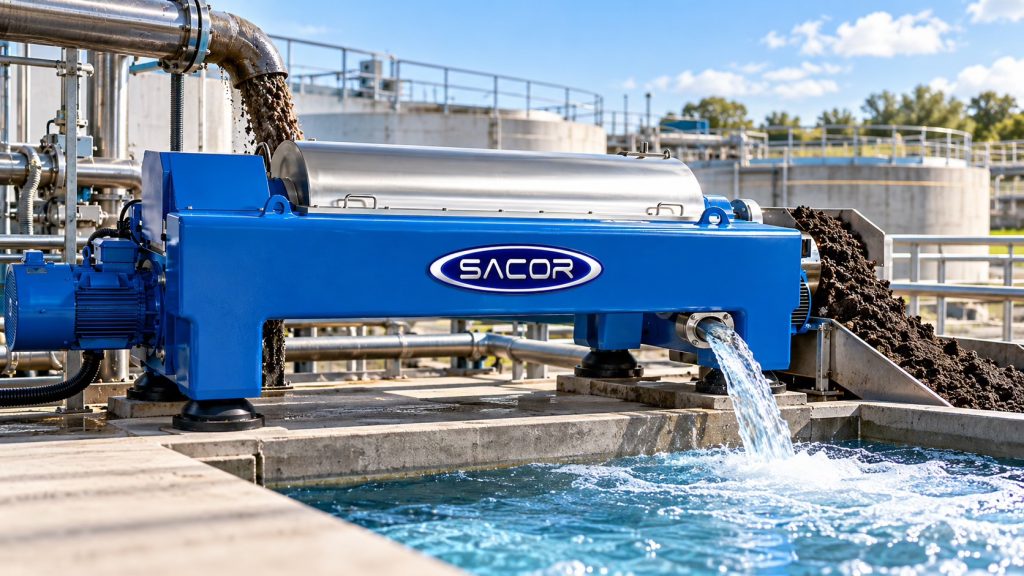
Inside the centrifuge, a rotating bowl generates centrifugal force, causing denser solids to accumulate along the bowl wall. An internal scroll conveyor continuously transports the separated solids towards the discharge outlet, while the clarified liquid exits separately.
This continuous separation process makes decanter centrifuges well suited to industrial sludge thickening and dewatering applications.
Key benefits can include:
- Reduced sludge volume and associated disposal costs.
- Improved solids handling and transportation efficiency.
- Continuous operation for demanding industrial processes.
- Reduced dependence on large settling areas.
- Improved liquid recovery for downstream treatment or potential reuse.
By increasing the solids concentration of discharged sludge, decanter centrifuges can significantly reduce the volume of material requiring further handling.
Disc Stack Separators: High-Efficiency Liquid Clarification
While decanter centrifuges are commonly used for sludge dewatering, disc stack separators are particularly valuable for liquid clarification and certain liquid-liquid-solid separation applications.
These machines operate at high rotational speeds and contain a series of closely spaced conical discs that increase the effective separation area.
This design enables the separation of fine suspended particles and, in suitable applications, liquids with different densities.
Disc stack separators can be used for:
- Fine solids removal from industrial process liquids.
- Oil and water separation where the feed characteristics are suitable.
- Clarification of process water.
- Recovery of valuable liquid or solid fractions.
- Supporting downstream filtration and treatment systems.
The selection between a decanter centrifuge and a disc stack separator depends on factors such as solids concentration, particle characteristics, liquid properties and the required separation outcome.
Where Does Centrifugal Separation Fit in a Wastewater Treatment Plant?
One of the most important considerations when designing a wastewater treatment system is understanding where mechanical separation provides the greatest benefit.
Centrifuges are not typically a complete wastewater treatment solution on their own. Instead, they form part of a broader treatment process.
Depending on the application, a treatment system may include:
- Pre-treatment: Screening, equalisation and other processes remove large debris and help stabilise wastewater characteristics.
- Primary treatment: Physical and chemical processes remove settleable solids, oils or other targeted contaminants.
- Biological or chemical treatment: Where required, additional processes address dissolved and biodegradable contaminants.
- Centrifugal separation: Decanter centrifuges or disc stack separators separate suspended solids, dewater generated sludge or clarify suitable liquid streams.
- Final treatment and water management: Further filtration, polishing or disinfection may be required before discharge or reuse.
The precise position of a centrifuge depends on the treatment objectives and the wastewater characteristics.
For example, a decanter centrifuge may be installed downstream of a biological treatment process to dewater waste sludge, while another system may use centrifugal separation earlier in the process to remove suspended solids.
The key is integrating the right separation technology at the right stage of treatment.
The Benefits of Centrifugal Separation in Industrial Wastewater Treatment
1. Reduced Sludge Disposal Costs
Sludge management can represent a substantial operating expense for industrial wastewater facilities.
When sludge contains excessive moisture, operators may be paying to transport and dispose of large quantities of water alongside the actual solids.
Effective mechanical dewatering increases the solids concentration of the discharged material, potentially reducing transportation requirements, disposal volumes and handling costs.
2. Improved Water Recovery
Water is an increasingly valuable operational resource.
By separating suspended solids from wastewater, centrifuges can help recover liquid that may be suitable for further treatment and potential reuse.
This can support facilities seeking to reduce freshwater consumption and improve overall water management.
However, additional treatment may be required to remove dissolved contaminants before recovered water can be reused or discharged.
3. Compact and Continuous Operation
Compared with some conventional gravity-based separation systems, centrifuges can provide high separation capacity within a relatively compact footprint.
Their ability to operate continuously makes them particularly valuable for industrial facilities processing ongoing wastewater streams.
4. Greater Process Control
Modern centrifugal separation equipment can be configured to accommodate changing process conditions.
Parameters such as bowl speed, differential speed and feed rate can be adjusted to optimise separation performance.
This flexibility is especially important in industrial wastewater applications where solids concentrations and feed characteristics may fluctuate.
5. Improved Resource Efficiency
Effective wastewater management extends beyond simply removing waste.
By recovering liquids, reducing sludge volumes and improving separation efficiency, industrial facilities can make better use of available resources.
This supports more sustainable industrial operations while potentially delivering measurable operational savings.
Choosing the Right Centrifuge for Your Wastewater Application
Not all industrial wastewater streams are the same, and selecting the wrong separation equipment can result in unnecessary operating costs and poor performance.
Before selecting a centrifuge, several factors should be considered:
- Solids concentration: The amount of suspended material present in the wastewater.
- Particle size and density: Characteristics that influence separation behaviour.
- Required cake dryness: The target moisture content of discharged solids.
- Liquid clarification requirements: The acceptable concentration of residual suspended solids.
- Chemical compatibility: Whether the wastewater contains corrosive or aggressive substances.
- Flow rate and operating conditions: The volume of wastewater requiring treatment.
- Maintenance and lifecycle costs: The long-term requirements associated with equipment operation.
A properly specified centrifuge should be selected based on the actual process requirements rather than equipment capacity alone.
SACOR: Specialists in Industrial Wastewater Separation
At SACOR, we understand that effective wastewater treatment requires more than simply installing a centrifuge.
Every industrial process presents unique challenges, and achieving reliable separation performance depends on selecting, configuring and maintaining the right equipment.
SACOR provides centrifugal separation solutions for a range of industrial applications, including wastewater treatment, sludge management, chemical processing and resource recovery.
Our capabilities include:
- Decanter centrifuges: Two-phase and three-phase separation solutions for suitable industrial applications.
- Disc stack separators: High-efficiency liquid clarification and separation technology.
- Equipment refurbishment and repairs: Restoring and maintaining centrifuge performance.
- Preventative maintenance: Supporting equipment reliability and reducing unplanned downtime.
- Process optimisation: Helping facilities improve separation efficiency and operational performance.
- Installation and commissioning: Supporting the integration of centrifugal separation equipment into industrial processes.
- Spare parts and technical support: Providing ongoing assistance throughout the equipment lifecycle.
Whether a facility is upgrading an existing wastewater treatment process, addressing poor sludge dewatering performance or investigating new separation technology, SACOR works to identify practical solutions tailored to operational requirements.
The Future of Industrial Wastewater Treatment
As industrial facilities continue to focus on water conservation, operational efficiency and environmental responsibility, effective solids management will remain an important part of wastewater treatment.
Centrifugal separation technology provides a proven mechanical approach to managing suspended solids, reducing sludge volumes and recovering liquid for further treatment.
When correctly specified and integrated into a treatment system, centrifuges can help industrial operators achieve more efficient and reliable wastewater management.
For industries seeking to improve wastewater treatment performance, investing in the right separation technology can deliver benefits well beyond the initial separation process.
Improve Your Wastewater Separation Performance with SACOR
Is your facility struggling with excessive sludge volumes, poor separation performance or increasing wastewater treatment costs?
SACOR specialises in centrifugal separation technology and provides equipment, maintenance and process optimisation solutions for demanding industrial environments.
Whether you require a new decanter centrifuge, equipment refurbishment or technical support for an existing installation, our team can help you explore the right solution for your application.
Contact SACOR today to discuss your industrial wastewater separation requirements.