
How decanter centrifuges sit at the beginning of every renewable energy supply chain.
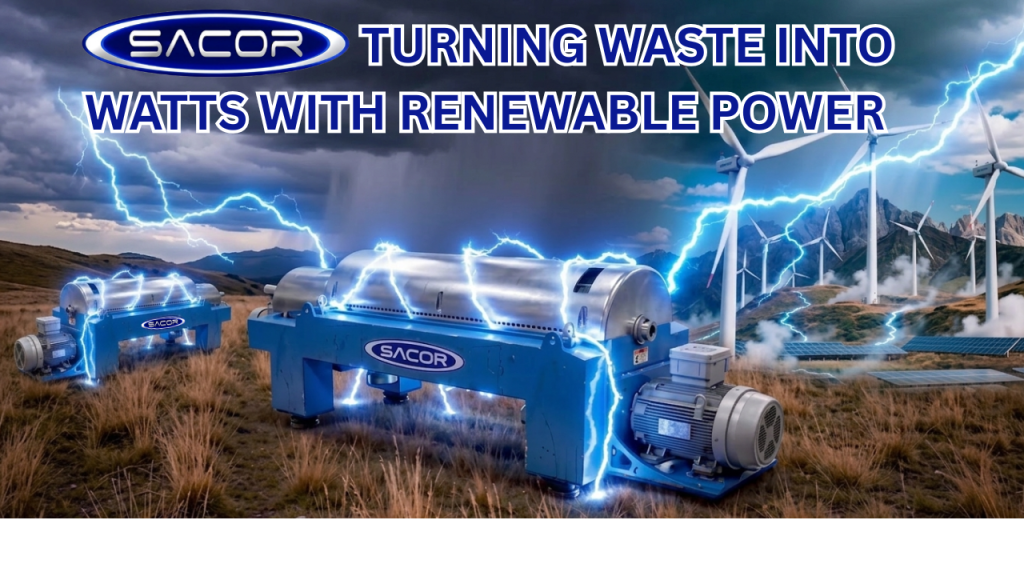
The unseen link in the renewable energy chain
Watch any documentary on renewable energy and you’ll see the same shots: turbine blades turning against a blue sky, rows of solar panels stretching to the horizon, engineers in hard hats standing next to battery storage units.
What you won’t see is the machine that made any of it possible.
Every wind turbine, every solar panel, every lithium-ion battery behind a solar farm began its life as a slurry – a mixture of ore, water and chemistry being spun at thousands of G to separate the valuable from the waste. That machine is a decanter centrifuge. And at Sacor, it’s what we build.
What’s actually inside a wind turbine and a solar panel
Before a single kilowatt of green electricity is generated, a staggering amount of mining and material processing has already happened.
A modern 5 MW wind turbine contains roughly:
- Rare earth elements (neodymium, dysprosium, praseodymium) – for the permanent magnets in the generator
- Copper – around 4 tonnes of it, in the generator windings and power cables
- Steel – several hundred tonnes in the tower and nacelle
- Aluminium – for the hub, nacelle cover and structural components
A utility-scale solar array needs:
- Polysilicon – the foundation of every PV cell
- Silver – for the conductive paste on each cell
- Aluminium – for the panel frames and mounting structures
- Copper – for wiring and inverters
- Lithium, cobalt and nickel – for the battery storage that makes solar viable after sunset
Every one of these materials passes through a wet process during extraction or refining. And wet processes mean centrifuges.
Where a Sacor decanter earns its keep
Copper. Copper is the backbone of any renewable installation. Large copper operations run tailings dewatering as a continuous, round-the-clock duty. A single SADEC 1050 running on duplex 2507 stainless can process up to 250 cubic metres of tailings slurry per hour. Without that separation step, the copper that ends up wound into every generator coil never gets shipped off the mine.
Rare earths. The neodymium magnet in a wind turbine generator starts life in an ion-adsorption clay deposit or a monazite sand. After acid or alkaline leaching, you’re left with a pregnant liquor full of ultrafine clay residue. A two-phase SADEC clarifies that liquor; a three-phase Delta-Canter handles the solvent extraction wash stages where aqueous, organic and solids all need separating at once.
Polysilicon. This one surprises people. When silicon wafers are cut for solar cells, the diamond-wire sawing process generates enormous volumes of kerf slurry – a mixture of silicon fines, silicon carbide cutting media, and glycol coolant. Decanter centrifuges recover both the silicon and the SiC. That material goes straight back into the solar supply chain instead of landfill.
Aluminium. Aluminium begins as bauxite, refined through the Bayer process into alumina and then smelted into metal. Every tonne of alumina leaves behind roughly 1.5 tonnes of red mud – the bauxite residue that is one of the largest waste streams in global industry. Dewatering and handling that residue is exactly the duty a decanter centrifuge is built for. Every aluminium turbine hub or solar panel frame in the world is downstream of that separation step.
Steel. Basic oxygen steelmaking (BOS) produces slurry streams rich in iron fines and scale. Decanter centrifuges dewater those slurries, recover the iron for re-smelting, and return clean water to the plant. Every tonne of structural steel in a wind tower or solar mounting frame is a direct beneficiary of that recovery loop.
Lithium, cobalt, nickel. Every battery behind a solar farm has a decanter somewhere upstream. Spodumene concentrate dewatering. HPAL laterite residue handling in nickel-cobalt operations. Direct lithium extraction (DLE) brine clarification. The battery chemistry changes; the separation principle doesn’t.
The other half of the story: water
A renewable energy mine isn’t “green” if it leaves a wet tailings dam behind. The era of upstream tailings dams is ending – regulators, communities and insurers are no longer willing to accept the risk.
Decanter centrifuges close that loop. A dry-stackable tailings solid, combined with recovered process water returning to the front of the circuit, is what modern responsible mining looks like. That’s not greenwashing. It’s engineering.
The bottom line
The renewable energy transition is, fundamentally, a materials transition. Every solar panel, every turbine, every battery is a concentrated expression of metals and minerals that have been separated from orders of magnitude more waste.
No separation, no materials. No materials, no turbine. No turbine, no green kilowatt-hour.
Sacor builds the machines that build the future.
Sacor Australia Pty Ltd designs, supplies and services decanter centrifuges, tricanters and disc stack separators for mining, minerals processing and industrial applications across Australia, Africa, The America’s and South-East Asia. To discuss a specific application, contact Chris Fletcher at chrisfletcher@sacor.com.au or +61 450 947 479.