The Problem with Conventional Tailings Management
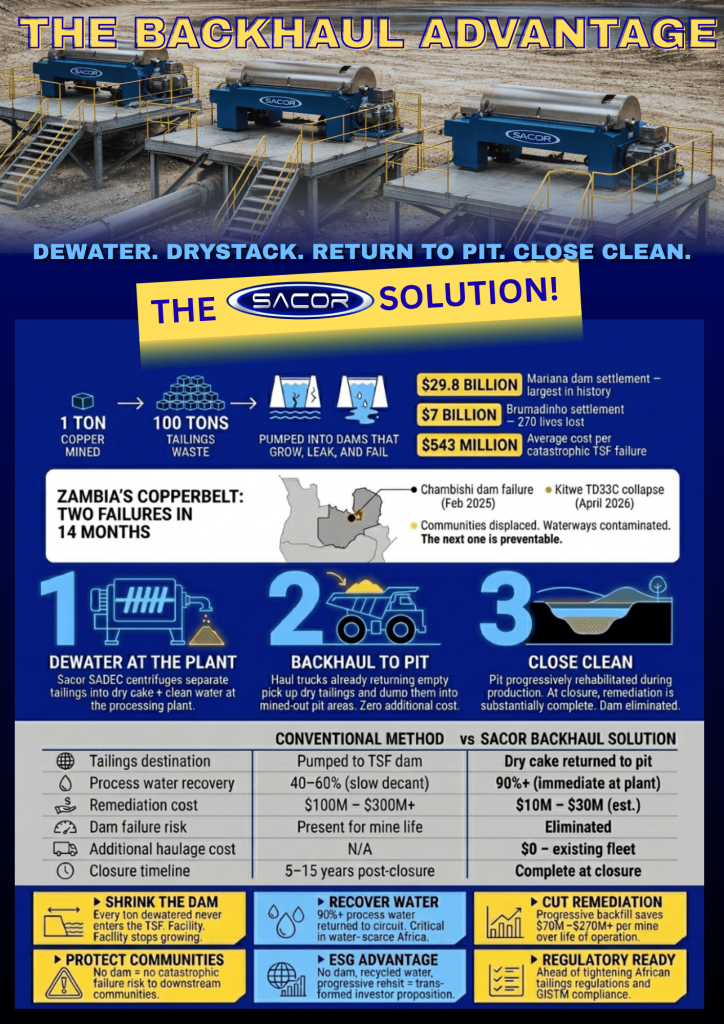
For every ton of copper mined, up to 100 tons of tailings waste can be generated. Historically, this waste is pumped into tailings storage facilities (TSFs), large dams that:
- Continuously grow over time
- Require long-term monitoring and maintenance
- Carry the risk of leaks or catastrophic failure
Recent global incidents and multi-billion-dollar settlements have highlighted the real cost of these risks, not only financially, but in terms of environmental damage and community displacement.
In addition:
- Water recovery is often limited to 40–60%, slowing operations and increasing water demand
- Closure timelines can stretch 5–15 years post-production
- Remediation costs can exceed $100M–$300M+ per site
This model is no longer sustainable.
Introducing the Backhaul Advantage
The Backhaul Advantage is a simple yet transformative concept:
Use existing haulage capacity to return dewatered tailings back to the mined-out pit, eliminating the need for tailings dams.
Instead of sending waste forward into growing risk, we bring it back safely, efficiently, and at minimal additional cost.
The SACOR Solution: A 3-Step Process
1. Dewater at the Plant
SACOR SADEC centrifuges separate tailings into:
- Dry cake (solid material)
- Clean process water (recovered and reused immediately)
This enables 90%+ water recovery, significantly reducing freshwater demand, critical in water-scarce regions.
2. Backhaul to Pit
Mine haul trucks, which typically return empty after delivering ore, are used to:
- Pick up dry tailings
- Transport them back to the mined-out pit
Result:
- No additional haulage cost
- Immediate integration into existing operations
3. Close Clean
As mining progresses:
- The pit is progressively backfilled
- Rehabilitation happens during operations, not after
At closure:
- The site is substantially complete
- No tailings dam remains
- Long-term liabilities are dramatically reduced
Quantifying the Advantage
| Metric | Conventional Method | SACOR Backhaul Solution |
| Tailings Destination | TSF dam | Returned to pit |
| Water Recovery | 40–60% | 90%+ |
| Remediation Cost | $100M–$300M+ | $10M–$30M (est.) |
| Dam Failure Risk | Present | Eliminated |
| Additional Haulage | N/A | $0 (existing fleet) |
| Closure Timeline | 5–15 years | Complete at closure |
Why It Matters
Shrink the Dam, or Eliminate It Entirely
Every ton of dewatered tailings is one less ton entering a TSF. Facilities stop growing, or disappear altogether.
Recover Water Where It Counts
With over 90% water recovery, operations become more resilient, especially in water-constrained regions.
Protect Communities
No dam means:
- No catastrophic failure risk
- No downstream contamination
- Greater trust with surrounding communities
Cut Lifecycle Costs
Progressive backfilling reduces total remediation costs by tens to hundreds of millions of dollars over the life of a mine.
ESG and Regulatory Readiness
- Eliminates one of mining’s biggest ESG risks
- Aligns with tightening global tailings standards (including GISTM)
- Transforms environmental performance into a competitive advantage
A Smarter Path Forward
The mining industry is at a turning point. Tailings management can no longer rely on legacy systems that carry high risk and long-term liabilities.
The Backhaul Advantage offers a practical, scalable, and cost-effective alternative, leveraging what mines already have to solve one of their biggest challenges.
At Sacor, we are proud to deliver solutions that not only improve operational efficiency but also redefine what responsible mining looks like.
The Future Is Backhauled
Dewater. Dry stack. Return to pit. Close clean.
It’s not just a process, it’s a shift in thinking.
The future of tailings management isn’t forward.
It’s back.