
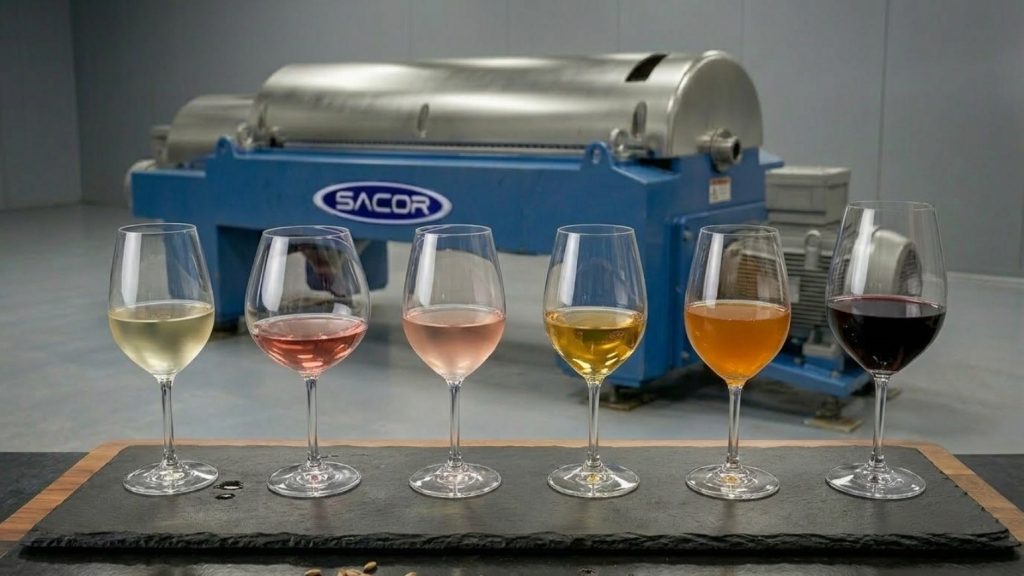
In modern winemaking, achieving exceptional quality while maintaining efficiency is a constant challenge. Wineries must balance clarity, flavour preservation, yield, and sustainability, all while meeting increasing production demands.
This is where SADEC decanter centrifuge separation technology is transforming the industry.
Sacor Australia is helping wineries rethink traditional processes by introducing advanced centrifuge systems that deliver gentle wine clarification, efficient lees management, and improved production performance, without compromising the artistry of winemaking.
The Challenge: Clarity, Yield, and Consistency in Winemaking
Winemaking is both a science and an art. From crushing and fermentation through to clarification and maturation, every stage impacts the final product.
One of the biggest challenges wineries face is removing unwanted solids, such as grape particles, yeast lees, and suspended materials, while preserving the wine’s delicate aroma and flavour profile.
Traditional methods like settling tanks and filtration can:
- Be time-consuming and space-intensive
- Lead to product losses
- Risk oxidation or flavour degradation
- Limit production efficiency
To stay competitive, wineries are increasingly adopting centrifuge-based wine processing as a smarter alternative.
How Decanter Centrifuges Work in Wine Production
Sacor’s decanter centrifuges use high centrifugal force to continuously separate solids from liquids.
The process is simple but highly effective:
- Wine or juice enters a rotating bowl
- Solids (grape skins, yeast, lees) are forced outward
- A screw conveyor removes the solids
- Clarified wine exits continuously
This enables fast, continuous wine clarification with minimal disruption to the production process.
Key Benefits of Sacor Centrifuges in Wine Production
1. Gentle Wine Clarification Without Compromising Quality
One of the most critical aspects of winemaking is preserving the wine’s character.
Sacor’s centrifuges are designed to deliver gentle clarification, removing solids while maintaining delicate aromas and flavours. This ensures the final product retains its intended sensory profile and meets high consumer expectations.
2. Brilliant Clarity and Enhanced Wine Quality
Centrifuge technology produces bright, clear wines by efficiently removing suspended particles.
This not only improves visual appeal but also enhances the overall organoleptic properties, including taste, aroma, and mouthfeel, resulting in a higher-quality final product.
3. Efficient Lees Management and Resource Recovery
Lees management is a major operational challenge for wineries.
Sacor systems streamline this process by:
- Separating wine from lees efficiently
- Reducing waste volumes
- Enabling recovery of valuable compounds like polyphenols and tartaric acid
This turns what was traditionally waste into a potential secondary revenue stream, improving overall profitability.
4. Increased Yield and Reduced Product Loss
Every drop of wine matters.
Sacor’s decanter centrifuges are engineered to recover maximum juice and wine from grapes and lees, ensuring higher yields and reducing losses during processing.
This directly improves production efficiency and margins while supporting more sustainable operations.
5. Flexibility Across Different Wine Styles
Whether producing red, white, or rosé wines, Sacor centrifuges offer the flexibility to handle different wine styles and processing requirements.
This adaptability allows wineries to maintain consistent quality across diverse product portfolios without needing multiple systems.
6. Continuous Operation and High Throughput
Unlike batch processes, centrifuges operate continuously, enabling:
- Faster processing times
- Increased production capacity
- Reduced reliance on large settling tanks
This makes them ideal for both boutique wineries and large-scale operations looking to scale efficiently.
7. Compact Footprint and Easy Integration
Space is often limited in wineries.
Sacor centrifuges are designed with a compact footprint and can be easily integrated into existing production lines, reducing the need for major infrastructure changes.
One Machine, Multiple Applications
A major advantage of Sacor’s technology is its versatility.
A single decanter centrifuge can be used for:
- Juice clarification
- Wine clarification
- Lees recovery
- Flotation lees processing
This reduces the need for multiple pieces of equipment such as presses and settling tanks, resulting in lower capital and operating costs.
Sustainability and Efficiency in Modern Wineries
Sustainability is becoming a key priority in the wine industry.
Sacor’s centrifuge technology supports this by:
- Reducing waste volumes
- Recovering valuable by-products
- Optimising storage capacity
- Improving overall process efficiency
By turning waste streams into valuable resources, wineries can move toward more sustainable and circular production models.
Supporting the Art of Winemaking with Advanced Technology
At its core, winemaking is about craftsmanship.
Sacor understands this, which is why their centrifuge systems are designed not to replace traditional expertise, but to enhance it. By combining engineering precision with process flexibility, wineries can maintain full control over quality while improving efficiency behind the scenes.
Conclusion: A Smarter Approach to Wine Production
The demands on modern wineries are increasing, from quality expectations to production efficiency and sustainability.
Sacor Australia’s decanter centrifuges provide a powerful solution, enabling wineries to:
- Achieve superior clarity and quality
- Maximise yield and profitability
- Streamline operations
- Reduce waste and environmental impact
By integrating advanced centrifuge technology into wine production, wineries can transform traditional challenges into new opportunities for growth and innovation.
The future of winemaking lies in combining tradition with technology, and centrifuges are at the heart of that evolution.